Californians all need to know the source of the water they rely on. Source determines how the water gets to them and whether there is actually enough to meet their expectations. Systems developed to acquire, move, and deliver water warrant scrutiny when we consider water rights and fairness, water quality, environmental impacts, and system resilience. These are all matters that the LWVC Water team would like to explore with League members in upcoming articles.
For a century, Californians have relied on moving inconceivably large amounts of water from where Nature deposited it and storing it behind massive dams until the water was moved. The backup has been to pump it out of the ground, treating that source as inexhaustible and often causing the land to subside. Here's an overview of California surface water development. (Federal projects are purple, state are green, and local are red.)
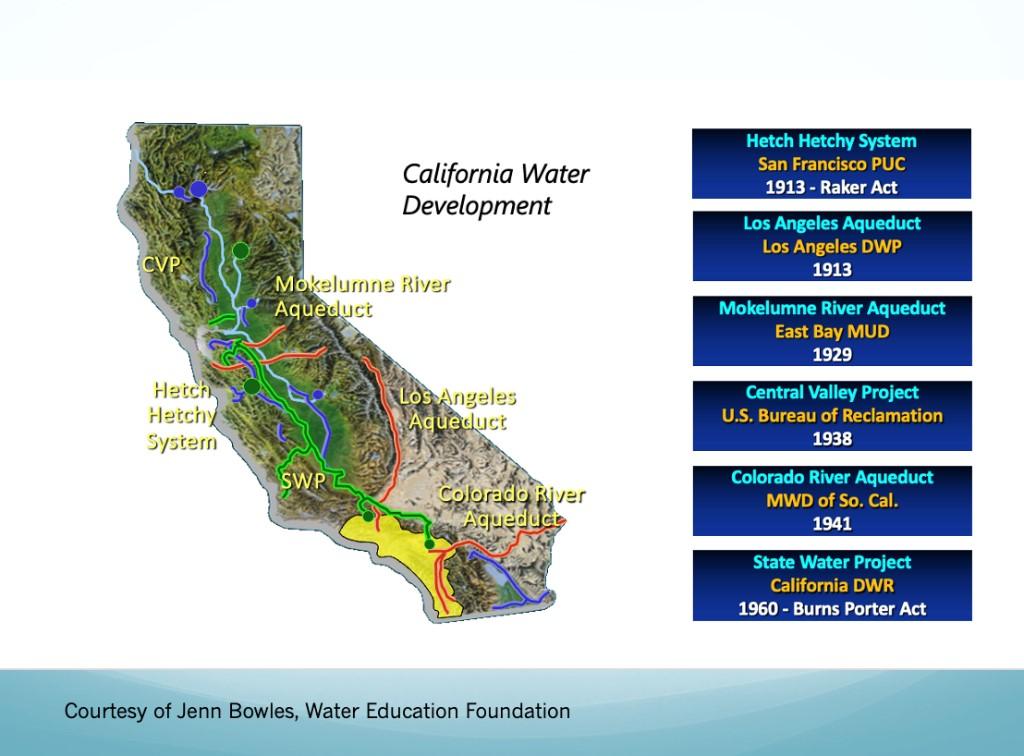
The Hetch Hetchy system, begun in 1913 by the San Francisco Public Utilities Commission (SFPUC), provides Tuolumne River water for use in the San Francisco Bay Area. This was the first project to begin reducing flows through the Sacramento-San Joaquin Delta and the Bay-Delta Estuary. Today, the SFPUC has an Urban Water Management Plan (UWMP). In February 2026, Sierra Club California and two regional Sierra Club chapters wrote to the SFPUC arguing that the Commission's draft 2025 UWMP is using unrealistically high demand projections that threaten ratepayer affordability as well as the Tuolumne River ecosystem and the Bay Delta.
Also in 1913, the Los Angeles Department of Water and Power--LADWP--began building the Los Angeles Aqueduct to bring water down the east side of the Sierras from Owens Lake and, when that was dried up, from Mono Lake, which is now severely damaged. As recently as this past fall, a plan to substitute recycled water in the LA Basin for Mono Lake diversions seemed to be moving ahead. The Mono Lake Committee reports that DWP hasn't so far followed through with that.
To serve the growing east San Francisco Bay population, in 1929 the East Bay Municipal Utility District developed the Mokelumne Aqueduct to send Mokelumne River water through buried steel pipelines under the Sacramento-San Joaquin Delta. EBMUD later added two dams upstream on the Mokelumne. This was the second major project to reduce natural flows through the Delta and Estuary, affecting farming and fisheries that rely on those flows.
The Central Valley Project (CVP), which serves primarily agriculture in the arid southern Central Valley, began with ground broken for Shasta Dam on the Sacramento River in 1937. The U.S. Bureau of Reclamation supervises the CVP, which includes the Friant-Kern Canal to serve growers on the east side of the southern Central Valley. The Bureau also owns B. F. Sisk (San Luis) Dam, which is operated by the California Department of Water Resources (DWR) and serves agriculture and a few urban users in both the Central Valley and in Santa Clara and San Benito counties to the west. The CVP and DWR have cooperated in managing Sacramento River flows for all uses, including fisheries, until recently.
Also during the Depression, work began on the Colorado River Aqueduct to bring water to metropolitan southern California. Disputes among the seven states on the Colorado River have arisen because less water is available than was originally allocated, and metropolitan Southern California, as well as the agricultural Imperial Valley, have been getting the largest amount. Original annual allotments to the seven states, established before 1950, totaled 15 Million Acre-Feet (MAF), and additional supplies were later promised to Mexico. (Tribal uses were never included in allotments.) However, never since 1930 have flows reached 15 MAF. This article explains the situation and contains a chart showing annual water supply from 1906 to 2023.
In 1960, California began building the State Water Project (SWP) to move additional water from north to south, primarily to urban Southern California but also to southern Central Valley agriculture. This required facilities to move water through the Sacramento-San Joaquin Delta. A bulletin published by DWR at the time says (page 11) that full demands on the system could be met until about 1981 "from surplus water in and tributary to the Delta with regulation by the proposed Oroville and San Luis Reservoirs. However, upstream depletions will reduce the available surplus supplies and water will have to be imported from north coast sources after that year." A graph shows that after 1981, meeting demand would require adding in water from the Middle Fork of the Eel River, the Trinity River, the Mad-Van Duzen, and the Klamath. But the California Wild and Scenic Rivers Act, passed in 1972, protected from development all those rivers. So five million AF of intended SWP water was never developed.
These are by no means all the dams and water projects--federal, state, and local--on which Californians rely. Many were developed with ambitious engineering but limited historical knowledge about the natural systems being modified. They did not consider the impact on one part of the state of moving water Nature put there to a different part of the state. The LWVUS Position on Water Resources has a lot to say about Interbasin Water Transfers, but the national position was developed in the late 1950s, and by that time, five of the six major water projects that Californians rely on had already been built.
Much of the system has relied on surface water that exists only on paper; a 2023 staff report by the State Water Resources Control Board reports (page 2-117) that the water authorized for diversion from the Sacramento River watershed is over five times the total annual average unimpaired flow for the entire Bay-Delta watershed. The environment, the fishing industry, and tribal uses have suffered. Fish are going extinct. Meanwhile, urban and agricultural water purveyors, and some of the public agencies that oversee them, have financial and political incentives to overstate water demand and perpetuate the existing systems.
For comments and questions please contact LWVC Position Director for Water, Jane Wagner-Tyack at jwtyack23 [at] gmail.com" href="mailto:jwtyack23 [at] gmail.com" data-linkindex="7">jwtyack23 [at] gmail.com.