In Spring 2026, I volunteered with my local League, LWV of Greater Pittsburgh, to register currently incarcerated eligible voters at our county jail ahead of the primary elections. This was my second time participating in this volunteer opportunity with the League; through it, I learned more about voting rights for currently incarcerated individuals (sometimes referred to as "returning citizens"). I also learned about their voter eligibility and the barriers that formerly and currently incarcerated voters face.
,
,
Felony Disenfranchisement & Voting Rights for Formerly or Currently Incarcerated Individuals
Alright, let's start with a civics checkup. In the United States, you can vote if you are:
- A US citizen
- Meet your state's residency requirements, and
- Are at least 18 years old by Election Day.
However, people convicted of a felony are stripped of their right to vote — this is known as felony disenfranchisement. According to The Sentencing Project, an estimated 4 million people are currently disenfranchised due to felony convictions.
The history of felony disenfranchisement in the United States is a racist one. From policing to sentencing, the disparities Black and Latino Americans face in our criminal justice system are staggering. The Color of Justice: Racial and Ethnic Disparity in State Prisons found that Black Americans are incarcerated in state prisons at nearly five times the rate of white Americans. Latino individuals are incarcerated at a rate of 1.3 times that of white Americans.
While the mass incarceration system disproportionately impacts people of color, felony disenfranchisement varies by state: for example, in Maine and DC, people with felony convictions never lose their right to vote. But for individuals with a felony conviction in Arizona or Florida, their right to vote is revoked indefinitely (unless the state government approves restoration). In Pennsylvania, voting rights are restored for individuals with a felony conviction after they are released from prison — meaning, if someone has already served their sentence and is not currently incarcerated, they can vote.
Find your local voting rules at VOTE411.org
While policies to re-enfranchise individuals with felony convictions have increased in recent years, America's current system of mass incarceration and disenfranchisement dilutes the political power of Black people, Latinos, and Native Americans, and continues to uphold our country's racist history.
,
,
Importantly, not all people currently incarcerated in jail or prison have a felony conviction. While some people I met at the county jail did have felony convictions and were unable to vote at that time, most individuals there were in "pretrial status," which means they were awaiting trial and had not been convicted of a crime. Other people who were incarcerated at the jail had been charged with a misdemeanor, which is less severe than a felony. Here in Pennsylvania, individuals who are incarcerated pre-trial, have a misdemeanor conviction, or are on parole or probation are eligible to register and vote.
Preparing to Register Incarcerated Voters
Before we were allowed to register voters, my local League set up a mandatory Zoom orientation to explain the process, rules, and resources. While I had registered incarcerated voters with the League before, it had been over a year, so I was a little rusty.
LWV of Greater Pittsburgh, in partnership with another local civics organization called the Black Political Empowerment Project (B-PEP), has been registering voters at the county jail for a few years. In 2025 alone, volunteers registered over 233 individuals and helped 260 incarcerated people apply for an absentee ballot. I learned after volunteering that LWV Greater Pittsburgh and B-PEP completed over 100 registrations for the 2026 primaries during their visits to Allegheny County Jail.
A week ahead of our visit, I hopped on a call with my fellow volunteers and our leaders for the initiative: Amy, the League’s civic education director, and Lorraine, B-PEP's civic engagement coordinator.
After introductions, Amy shared several resources (one thing about League members is that they are prepared!), including policies for jail visitors, a script for volunteers with directions for voters on completing an absentee ballot or registration application, and videos on the importance of midterm elections. We went over voter eligibility for incarcerated individuals in Pennsylvania and common issues volunteers saw when registering voters.
,
To register voters near you, search our 800+ state and local Leagues.
,
The night before our volunteer day, I looked at the documents one last time, trying to absorb everything. The jail has specific policies about what visitors are allowed to bring inside — no pens, notebooks, packets, just you! Fortunately, all the other documents we reviewed on the call, including voter registration and absentee ballot applications, would be printed out at the jail ahead of time for volunteers to grab before going to the pods.
A Day in the Life Registering Incarcerated Voters
The Morning Of
6:00 am: My least favorite part of the day is the early wake-up, but I had to be downtown at the jail by 8 am sharp! My alarm went off, and it was time to get ready. I brushed my teeth and woke up my very sleepy and not-a-morning-dog, Ginger, for her morning bathroom break.
6:20 am: My family, friends, boyfriend, and Ginger can all attest to this: I am serious about breakfast. As they say, breakfast is the most important meal of the day! I got cooking with gas (well, not really; I have electric) and whipped up some eggs, a bagel, and my French press.
6:40 am: I threw my dishes in the sink and got changed. The jail has a specific dress code, so no sleeveless shirts or neon colors for me. I threw on some jeans and my favorite University of Pittsburgh (#H2P) t-shirt, which would become quite the topic of conversation at the jail.
,
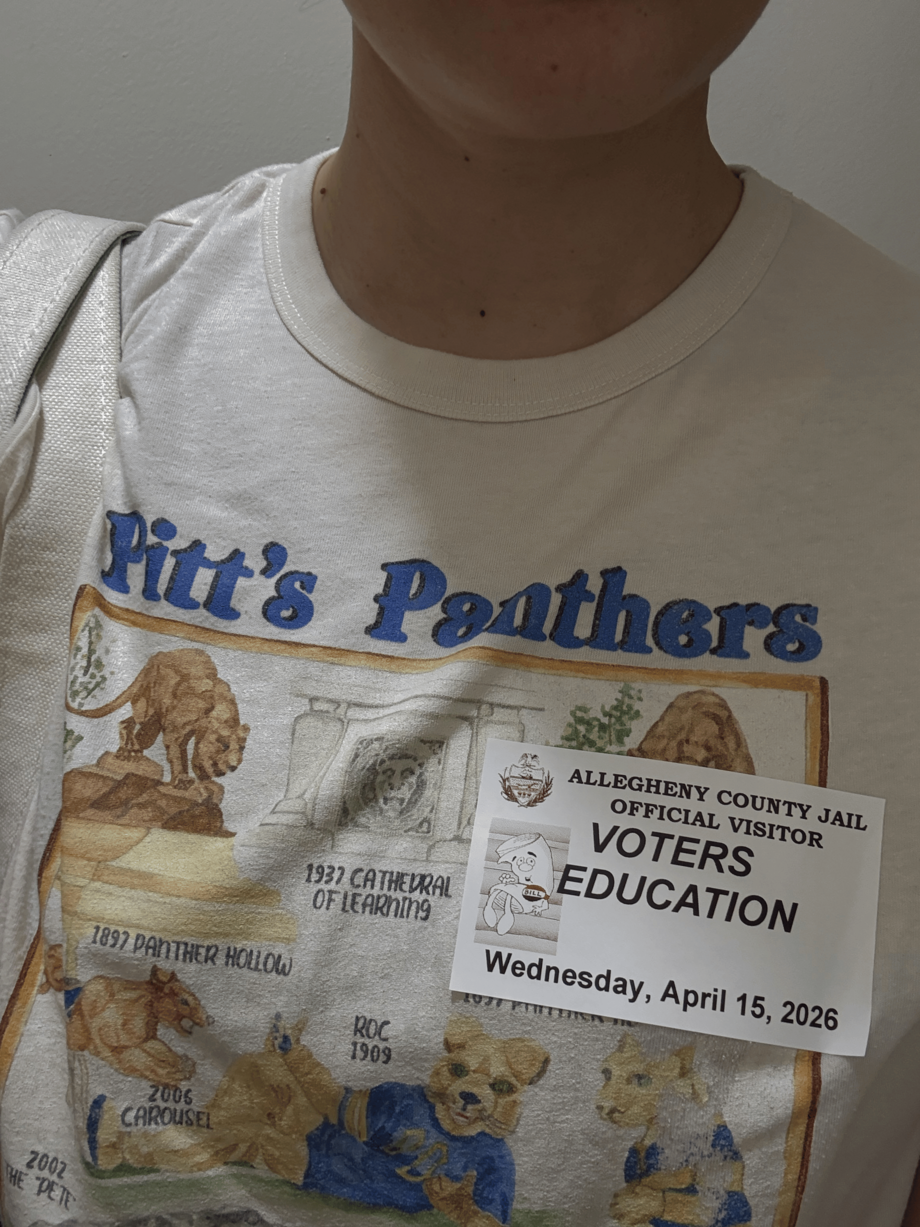
The author's famous shirt
,
6:50 am: I am somehow always running out the door to get the bus, but I made it on time and hopped on the bus downtown.
7:30 am: Hello, downtown Pittsburgh! It was a sunny, beautiful spring morning, so I decided to get off a stop early and walk to the jail.
7:45 am: Whew, I made it! I pressed the buzzer to be let into the jail entrance. The entrance is split in half by a big glass wall with a security booth in the middle, separating the check-in area from a little locker room. On our orientation call, Amy and Lorraine mentioned bringing a quarter to rent a locker and drop off your coat, bags, phone, and other personal items. As an Aldi regular, I always have that quarter on me. I dropped everything in my locker except my driver’s license and went through jail security.
Next, I headed towards the check-in desk.
,
,
I gave the guard my ID, and he signed me in and gave me a visitor sticker. The check-in desk held my ID until we were checking out for the day.
While I was checking in, the guards started talking to me about my Pitt shirt, which features all the Pitt Panthers from over the years. One guard started joking around and said they should give me a Penn State visitor sticker — not a laughing matter to a proud Pitt Panther like me! I was happy with the stickers we got, which have the little Bill of Rights character from Schoolhouse Rock! on them. I sat down and chatted with the other volunteers while we waited for everyone to arrive. I also got the chance to meet Casey, an employee for the county who organizes support programs for individuals incarcerated at the jail.
8:10 am: With all the volunteers finally checked in, a guard with a handheld metal detector checked each volunteer one last time, and Casey led us downstairs to a meeting room. From this point on, I wouldn't have access to a clock and wouldn't know the time until I left.
Registration Begins
Once we got to the meeting room, Casey went over the setup of the program and split the group into teams. Each team consisted of two volunteers and two caseworkers — they work directly with incarcerated individuals at the jail to provide resources and guidance — and was assigned to a specific floor. Each floor consisted of various pods with incarcerated individuals, so teams walked from pod to pod to register voters. The number of people we saw varied by pod, since some of the individuals we met were confined to cells or in handcuffs. Both men and women are incarcerated at our county jail, but most of the people we met were men; at the time of my visit, over 80% of the jail’s incarcerated population were male.
,
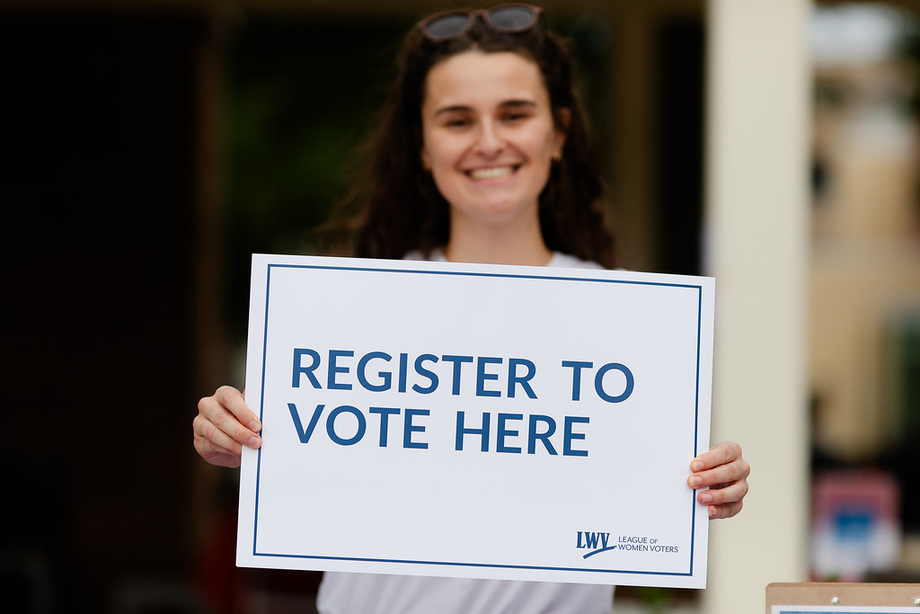
The author at another voter registration event
,
I met my team and grabbed our supplies. Since we couldn't bring anything in with us, Casey printed copies of the voter registration and absentee applications, our scripts, and instructions. We headed to our floor, which housed the jail's in-house hospital and medical services.
Because we were on the medical floor, the makeup of the pods really looked different! The men in our first pod were recovering from injuries or conditions, so nurses and medical professionals regularly came in to administer medication. But in every pod my team and I went to, the process was the same: we asked if anyone wanted to register to vote, wanted to update their registration, or needed to apply for an absentee ballot.
Voter Registration & Assisting with Absentee Ballots
For people registering to vote, I gave them a form and a pen. I then stood nearby and got to know folks, staying ready to answer any questions.
The most common question we got when it came to filling out the registration form was about the "Your Address” section.
,
,
Further complicating things, they couldn't put the jail as their primary residence. I also got a lot of questions about party affiliation. Some people asked what party to register for, or if they even had to choose a party. The League never tells anyone who to vote for or which party to register with, but I did highlight Pennsylvania’s closed primary system — that only registered Democrats or Republicans are able to vote in our primary elections.
Some individuals didn't have any questions, so we just chatted. Most asked about my Pitt shirt and my time there, where I was from, and if that meant I was a Pats fan. Someone asked me if my Brooks running shoes were comfortable (highly recommend).
,
,
For currently incarcerated individuals who knew they would be out of jail by Pennsylvania's primary on May 19, all they needed to do was register to vote. But for currently incarcerated individuals who would still be at the jail on or after Election Day, they needed an absentee ballot application. As I usually do when registering people to vote, I stood nearby while folks filled out their absentee ballot applications, ready to answer questions. There weren't as many questions when filling out this form, since the address to mail the ballot and reason sections were already filled out.
Once people finished their applications, my partner and I would take a glance to make sure nothing was missing and collect the completed forms. Then we'd march on to the next pod!
In almost every pod, I was asked about the midterm election itself. "What are we voting for?" "Who will be on my ballot?"
,
,
Individuals incarcerated at my local county jail are provided with tablets that include content like a library of books, news, educational materials, and more. The county jail uploads the League's voter guide from VOTE411.org to tablets to ensure incarcerated voters have the information they need to cast an informed ballot.
Saying Goodbye
After my team and I completed all the pods on our floor, we helped another team finish up registrations and applications. Once the team finished our last floor, we went back to the meeting room to organize completed applications for Casey, who reviews each application before sending them to the county election office. I said thank you to my team and our caseworkers, who invited us for a quick lunch, but I couldn't stick around. I headed upstairs to check out and make my way home, back with Ginger by 11 am.
The League’s Work with Incarcerated Voters
Leagues across the country are doing critical work to ensure that eligible, currently incarcerated voters can make their voices heard. Just a few of those Leagues include:
- Massachusetts: Local League members and staff from LWV of Massachusetts wrote about their experience registering voters at a local county jail.
- New Jersey: Since 2018, LWV of Monmouth County, NJ, has led their “Reenter-Register-Vote" program to empower citizens returning from jail or prison in their right to vote.
- Kentucky: In 2020, LWV of Kentucky organized a Civil Rights Restoration campaign following an executive order from the governor that restored voting rights to over 175,000 Kentuckians.
Get involved with your local League today!
,
,
How You Can Empower Incarcerated Voters
The criminal justice system is just one example of how US institutions have systemically upheld white supremacy and suppressed Black political power, from the Naturalization Act of 1790 and the US Supreme Court’s decision in Dred Scott, to Jim Crow laws, redlining, voter ID, and gerrymandering.
The League is committed to ensuring that every eligible voter is able to cast their ballot — and that means restoring voting rights to formerly incarcerated individuals with felony convictions.
You can get involved in empowering currently and formerly incarcerated voters! Here are a few ways:
- Donate to organizations committed to ending mass incarceration, supporting formerly incarcerated voters with reentry into non-carceral life, and advocating for positive policy changes, like the Equal Justice Initiative (EJI), The Sentencing Project, The National Reentry Network for Returning Citizens, and the Abolitionist Law Center.
- Learn more about the racist history of the incarceration system and its impact on voters with books like The New Jim Crow, documentaries like 13th, and policy briefs like this one from The Sentencing Project.
- Reach out to your local League to learn more about what they’re doing to ensure individuals impacted by mass incarceration can make their voices heard.