This blog was written by Federal Policy and Advocacy Manager Kristen Kern and Justice Reform Legislative and Policy Manager Rebecca Goldman.
Throughout the first year of the 119th Congress, the League of Women Voters did advocacy work around legislation with significant implications for both our democracy and the people within it. This blog looks back at five of the most consequential legislative battles of 2025, as well as their implications for our country and the League’s 2026 advocacy work.
The SAVE Act and Other Documentary Proof of Citizenship Proposals
The SAVE Act passed the House of Representatives in 2024, 2025, and, with some updates, again in February 2026. The SAVE Act, in all its forms, would put up barriers to voting by requiring American citizens to provide very specific documents when registering to vote and updating their voter registration. Chiefly, they would need to provide a passport or an original copy of their birth certificate, in person.
Tell Your Senators to Oppose the SAVE Act
The most recent iteration of the SAVE Act would require voters to show a photo identification when voting at the polls, in addition to requiring documentary proof of citizenship to register to vote. This would be an unnecessary addition to the voter identification laws that the majority of states already have in place. The bill also requires all states to run their voter lists through the Department of Homeland Security’s Systematic Alien Verification of Entitlements (SAVE) system to identify voters who may be noncitizens. Notably, this system is not equipped to determine voter eligibility and has demonstrated numerous shortcomings in its ability to accurately track citizenship status.
In all, the SAVE Act would suppress voters while offering no substantial election protection.
,
,
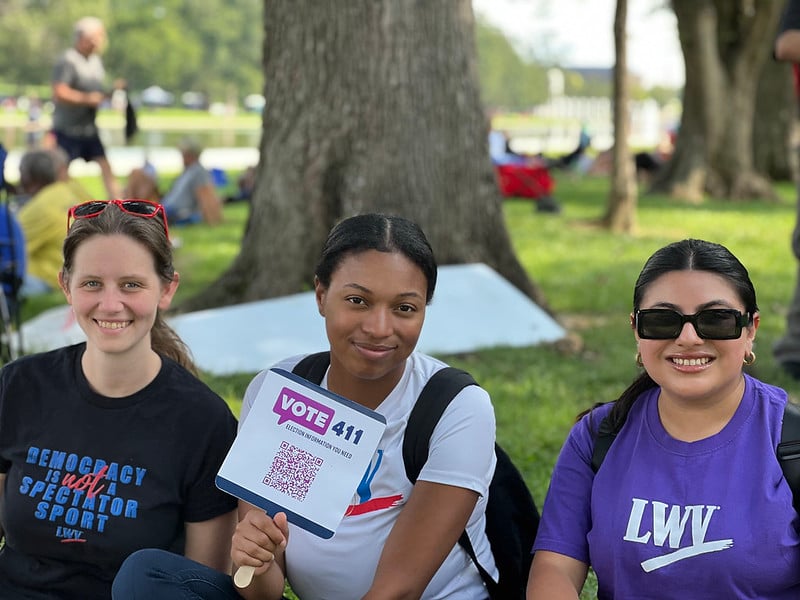
LWVUS and our partners have educated the public about the SAVE Act, mobilized hundreds of thousands of voters across the country to oppose this legislation, and prevented passage of the bill over the past few years. We are currently focusing our advocacy efforts on the Senate.
The One Big Beautiful Bill: Cuts to Health Care and Nutrition, Funding to ICE
Early in 2025, Congress was working on reconciliation, a fast-track legislative process to pass a government budget bill with taxes and mandatory spending (e.g., Medicaid, Medicare, and Social Security). Congress planned to make massive cuts to Medicaid, a government program insuring nearly 72 million children, pregnant people, parents, and older adults with limited incomes, and people with disabilities. As Congress was authoring, debating, and voting on legislation, LWVUS advocated against Medicaid cuts, emphasizing the impact they would have on people’s health and well-being.
Despite significant efforts by the advocacy community, Congress passed the legislation known as the One Big Beautiful Bill, with the largest cuts to Medicaid in the program’s history. The cuts are estimated to cause 10 million more people to become uninsured by 2034. The bill also makes cuts to Medicare and the Supplemental Nutrition Assistance Program (SNAP; formerly food stamps) and defunds Planned Parenthood. Read more about the bill here.
,
,
This reconciliation bill also allotted $170 billion, an unprecedented amount of funding, to expand immigration, detention, and border enforcement activities. This funding went to the Department of Homeland Security (DHS) and the Department of Defense. It includes $45 billion to build new detention centers, nearly $30 billion for Immigration and Customs Enforcement (ICE) and deportation, and $13.5 billion to reimburse state and local enforcement to perform immigration functions. Notably, ICE, Customs and Border Protection (CBP), and other DHS agents have conducted sweeping assaults on the rights of everyday Americans, sometimes resulting in detention, arrest, deportation, injury, and death.
The Government Shutdown: Impacting Basic Human Needs and Health Care
On October 1, 2025, the federal government shut down after Congress failed to pass a budget bill on discretionary (non-mandatory) spending for 2026. The disagreement hinged largely upon whether to extend the Affordable Care Act (ACA) enhanced premium tax credits, which help people afford their health insurance. These tax credits, or subsidies, were set to expire on December 31, 2025, and if they were not extended, would result in an estimated 4.8 million people becoming uninsured in 2026.
,

,
The shutdown lasted more than 40 days, making it the longest in US history. During that time, more than one million federal employees went unpaid, and 42 million people who receive SNAP benefits to afford food faced disruptions in their food access. Ultimately, Congress passed a continuing resolution, a temporary funding measure, with most funding running out on January 30, 2026. In order to strike this deal, the Senate also agreed to bring an ACA enhanced subsidy extension bill for a vote. On January 8, the House of Representatives passed a bill to extend the ACA subsidies for 3 years. The Senate has yet to bring it to the floor.
During the shutdown, LWVUS sent a letter to Congress urging them to address people’s basic needs and affordable health care in their continuing budget negotiations. Ahead of the vote on ACA subsidies, LWVUS urged the Senate to address health care affordability. After the vote was blocked by a filibuster, the League urged senators to come together on a bipartisan solution before the end of 2025.
The Equal Representation Act
Last year, the House and Senate introduced the Equal Representation Act, which proposes adding a citizenship question to the 2030 Census. The bill would exclude noncitizens from the apportionment process, which determines the number of members each US state has in the House of Representatives.
,
,
This bill is unconstitutional and violates the 14th Amendment, which requires the apportionment of the seats in the House of Representatives to be based on “the whole number of persons in each State” regardless of citizenship. Given that this bill seeks to change the constitutional mandate for the census, it would require a constitutional amendment, which Congress cannot do through mere legislation, as set forth in Article V of the Constitution.
The addition of a citizenship question is unnecessary and would lead to a less accurate census, which is not what our country needs. Census data is used to determine where billions of dollars of federal funding are shared with communities across the country for things like roads and transit systems, schools, hospitals, veterans’ care, disaster preparation, and many other important quality-of-life services. It is vital that these resources be funded proportionately to the number of people in each community, as they are used by people regardless of citizenship status. An inaccurate census will only hurt Americans who need support in states and communities across the country.
DC Autonomy
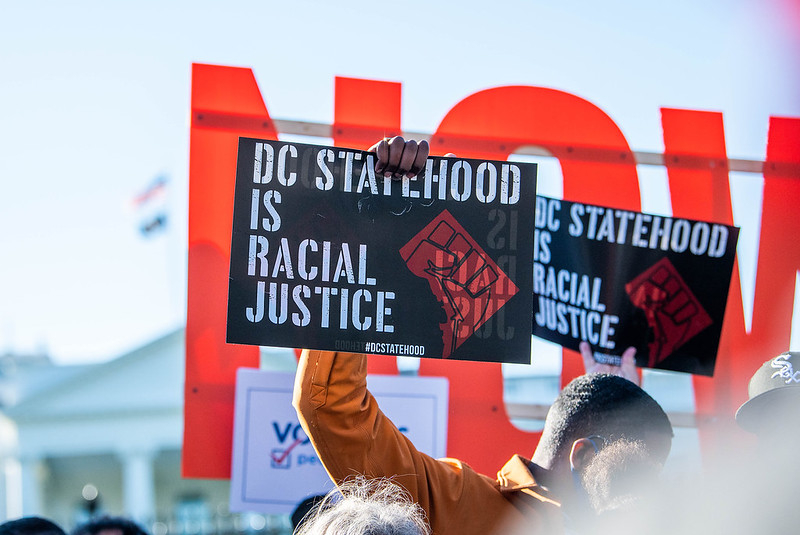
The people of the District of Columbia do not have a voice in Congress to advocate for or against federal policies that affect their everyday lives. Since DC does not have statehood, its local laws — and its annual budget — are subject to congressional oversight. Congress has used its power to disapprove DC’s local laws many times in the past few years, including in 2025 and 2026.
,
,
Congress has insisted on overturning numerous existing laws enacted by DC’s elected officials that would have addressed concerns of significant importance for DC residents. In doing so, congressional action has undone the hard work of DC’s elected officials and disregarded the voices of the District's citizens. The people of Washington, DC deserve the same rights as their fellow Americans living in the 50 states. This includes full voting representation in the US Congress and the end of congressional interference in their local government.
As such, the LWVUS Board selected protecting DC’s right to continue governing itself as a legislative priority for 2026. Every time that Congress proposes to overturn a DC policy, LWVUS and LWVDC send multiple letters to members of Congress reminding them that it is antithetical to the democratic principles they have taken an oath to protect to interfere in DC’s affairs.
What You Can Do
- Tell your senators to oppose the SAVE Act
- Tell Congress that federal immigration enforcement has gone too far
- Urge Congress to stop interfering in DC
- Check out our blog on advocating to your members of Congress during congressional recesses.
- Join your local League to learn about and support efforts to advocate for the needs of your community.
- Check out our Unite & Rise 8.5 initiative and commit to helping us build a network of people taking nonviolent action from their homes or in the streets to protect and restore our democracy.
- Discuss what has happened in the 119th Congress accurately with friends and family using resources like this blog!