It’s Juneteenth. Today, we honor the emancipation of the last enslaved Americans and recognize the painful history, extraordinary resilience, and generations of activism that made that moment possible. It’s a celebration that’s not only historic, but for many (like myself), deeply personal.
But in a moment when civil and voting rights continue to face challenges, and even efforts to acknowledge our full history through initiatives like Diversity, Equity, and Inclusion (DEI) are viewed as controversial, Juneteenth invites a larger question: what does this day mean? What does it symbolize for our democracy and for each of us, regardless of race?
,
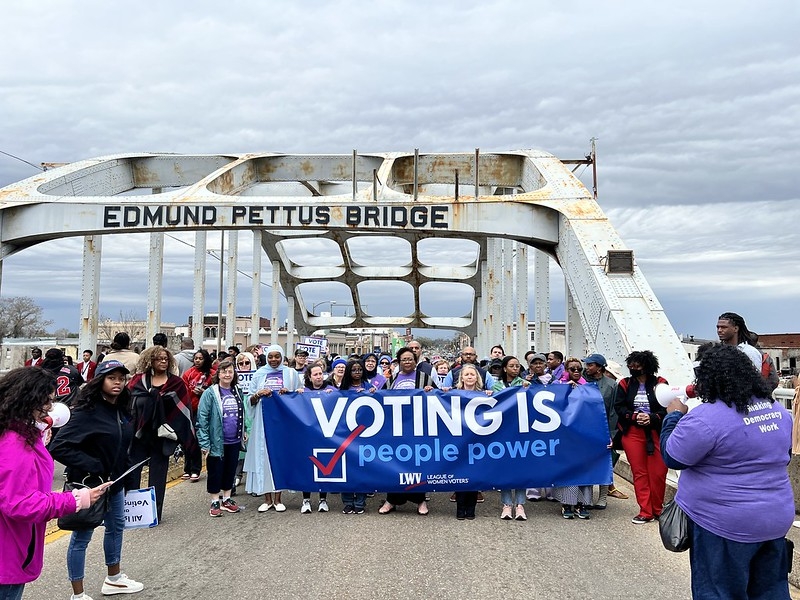
,
Juneteenth: A National (and Personal) History
While many folks learned about Juneteenth for the first time in 2021, when then-President Joseph Biden made it a national holiday, Juneteenth has always been a part of my life. My dad is from Galveston, Texas, AKA the town that inspired the celebration.
Here’s what happened: on June 19, 1865 — two whole years after President Abraham Lincoln signed the Emancipation Proclamation — Union General Gordon Granger arrived in Galveston, where he found hundreds of people still subjugated to slavery. He issued “General Orders, No. 3,” which proclaimed that all enslaved people were now emancipated. From then on, June 19 was celebrated as “Juneteenth,” “Freedom Day,” or “Emancipation Day,” originally just in local celebrations, but then across the country as residents of Galveston traveled across the US.
,
Stay Updated
Keep up with the latest democracy news. Receive emails to your inbox!
,
As a child, my family traveled to Galveston during the summers and some holidays, so I not only heard stories about Juneteenth from my Dad but also experienced the celebration firsthand. To me, Juneteenth was like Mardi Gras, a day when schools and business shut down and the people gathered in the streets, opened their doors, and went house to house eating popsicles and barbecue.
It was a multicultural celebration; Galveston not only has a large Black population but a significant Latino one, since it’s so close to the Gulf of Mexico. About a fifth of the population identifies as multiracial in a literal embodiment of how diverse American experiences converge in this small but significant town. On Juneteenth, people of all identities come together, not just to laugh and eat sausage sandwiches (on white bread, of course) but also to show the power of leveraging our voices together in unity and hope.
,
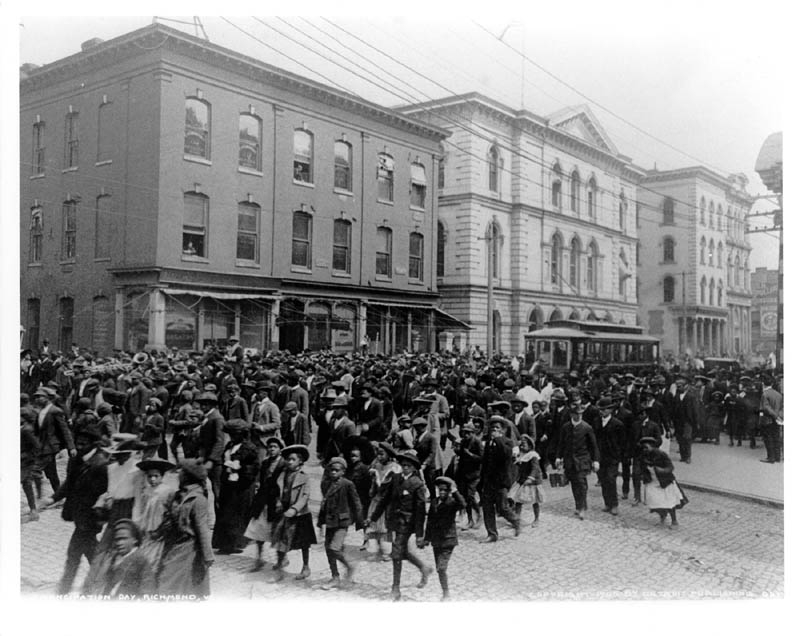
"Emancipation Day" celebration in Richmond, VA, in 1905
,
Growing up, I assumed everyone knew about Juneteenth. It wasn’t until later in life, when my family moved to the East Coast and then in college, that I learned many people had never been introduced to this part of American history.
Why Juneteenth Matters: Our History of Collective Liberation
When Juneteenth became a national holiday, Vice President Kamala Harris stated, “These are days when we as a nation have decided to stop and take stock, and often to acknowledge our history.” I imagine that, as the first Black and female Vice President, she had strong feelings about how far our nation had come since 1865 and what it meant for her to be part of the administration that made Juneteenth a national celebration.
,
,
It marked the beginning of liberation for people who had been violently torn from their homelands, separated from their families, stripped of their culture, language, and identities, and forced to build lives under a system designed to deny their very humanity. Freedom did not arrive with a blueprint. There was no clear path for people who had been deliberately excluded from every institution that defines citizenship. They had to imagine, build, and fight for a future that no one had prepared them to inherit.
As we celebrate Juneteenth, we celebrate one of the defining ideals on which our nation was founded: that no person should live under oppression and that every person deserves to live free. It was this conviction that inspired the American colonies to break free and emancipate themselves from English rule and declare that liberty was an unalienable right. Yet, for millions of enslaved Black Americans, that promise remained out of reach. Juneteenth represents one of the moments when our nation took a meaningful step towards resolving that contradiction, bringing our democracy closer to the ideals on which it was founded.
,
,
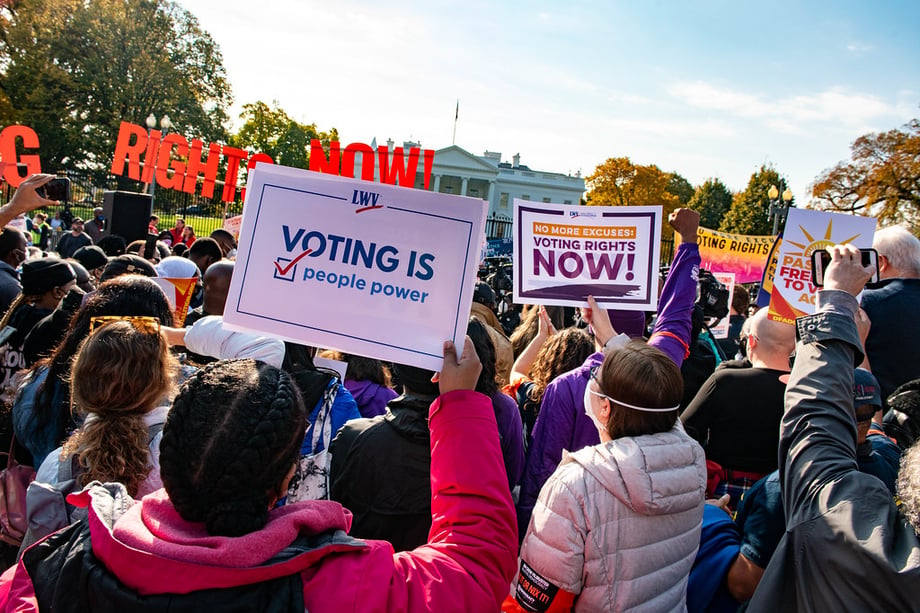
Juneteenth also illustrates how that core belief has expanded to include more people throughout America’s history, from colonists to enslaved Black Americans and more. The story of Juneteenth and collective liberation goes hand in hand with the stories of the League’s suffragist foremothers, the work of immigrant rights groups, and the fight of the LGBTQIA+ community. It is part of a constant arc leaning both towards greater freedom, a liberty that encompasses all who call themselves Americans.
Why is Juneteenth “Controversial?”
Juneteenth has become part of a broader debate over pluralism in American life. Specifically, over whose stories deserve recognition in America, whose experiences are centered, and what it means for a democracy to reflect the full complexity of its people. Efforts to acknowledge the experiences and contributions of historically marginalized communities, from policies like affirmative action and Diversity, Equity, and Inclusion (DEI) practices, to many initiatives that explore race, immigration, and our nation's complex history, have more than ever been characterized by some as motivating division rather than unifying.
,
,
Since the beginning of his second term, President Donald Trump has taken a series of swift actions to dismantle or crack down on DEI and related initiatives, accusing them of spreading the “pernicious and false belief” that America is “irredeemably racist and sexist.” In addition to ending equity-related grants, revoking affirmative action requirements, mandating that officials prepare to eliminate federal funds for schools that “indoctrinate” children based on “gender ideology” and “discriminatory equity ideology,” he declined to recognize Juneteenth publicly. Instead, on Juneteenth, rather than publicly commemorating the holiday, the President has used social media to criticize “non-working holidays” as harmful to the economy. He has also removed Juneteenth and Martin Luther King, Jr. Day as days when Americans can enter national parks for free, declaring his birthday a free park day in their place.
The Trump Administration wants us to think of Juneteenth, and any other acknowledgement of our country’s complicated racial history, as harmful and “anti-American.” I, like many Americans, strongly disagree. Our history may be nuanced and, at times, painful, but understanding is not optional; it’s critical.
I think of it like knowing my own medical history. There may be moments in there that were really challenging, or that in some ways I’d like to forget. But I can’t truly understand myself — and ensure I’m protecting my future health — unless I know the full story.
,
,
The great author William Faulkner (no stranger to the nuances of racial justice and identity) once said that “the past is never dead. It’s not even past. All of us labor in webs spun long before we were born, webs of heredity and environment…of history and eternity.”
Juneteenth, emancipation, and the legacy of slavery do not sit safely in the past; they live with us every day in our own laws, our institutions, and our national memory. That knowledge is not a condemnation. It is an invitation to see more clearly, to understand more fully, and to build a democracy capable of finally living up to its own ideals, which is the first step towards true liberation.
Why Juneteenth Matters More Than Ever
Our nation is under significant strain. Across party lines, social class, gender, sex, race – everyone is feeling it. The rising cost of basic goods, a volatile housing market, the discriminatory harms against immigrant communities through ICE enforcement actions, and the slow but steady deterioration of our basic rights, from reproductive care to the right to vote by mail, are all placing real pressure on American life.
At times like these, it is worth remembering that democracies are periodically tested. Many political scientists note that even the most enduring democracies tend to evolve, fracture, and reform over cycles that oven span roughly 200 to 250 years. If that is true, then what we are experiencing heading into America’s 250th anniversary is not outside of the historical pattern of democratic life, but it is a defining stress test of whether our institutions can once again adapt and expand their circle of belonging.
,
,
Moments of strain have repeatedly forced the nation to confront whether its ideals apply to the masses, or only to a few. That question is not new, but it is urgent in every generation that inherits it. And even in these moments, history shows that the expansion towards freedom has always depended on sustained struggle, collective action, and an insistence that the meaning of equality must grow over time.
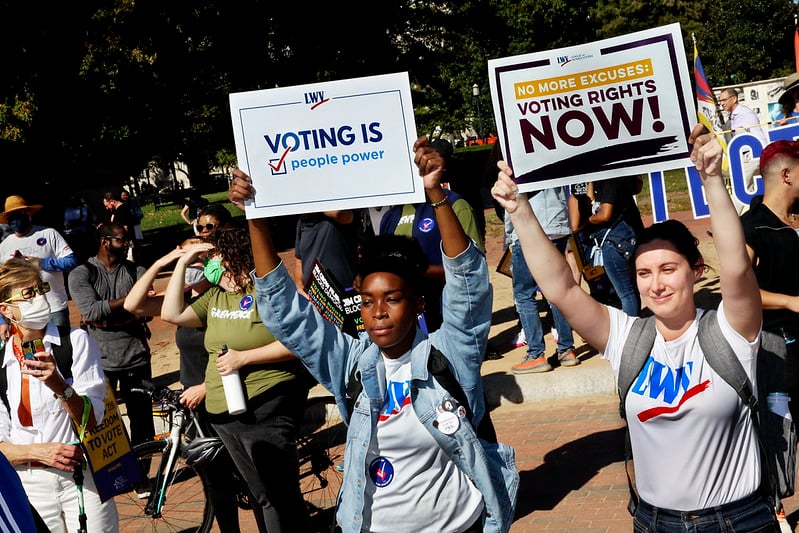
And yes, Juneteenth also has a particular resonance for Black voters in this moment. In May 2026, the Supreme Court struck a brutal blow to the rights of voters of color in its decision in Louisiana v. Callais. This decision weakened Section 2 of the Voting Rights Act, which prohibits any voting rule or procedure that discriminates on the basis of race, color, or minority language. By weakening Section 2, the Supreme Court made it extremely challenging for anyone to legally oppose racially discriminatory voting practices at the federal level. Since the decision, a slew of states have redrawn their congressional voting districts, and Black and brown voters have become the intended collateral damage.
Callais was not only a devastating legal blow, but a psychological one. The Voting Rights Act was a protection that voters of color hung our hats on; we may not have social, economic, or physical protection from discrimination, but we had legal protection. Now, we must navigate the world without one of the most critical safeguards for making our voices heard.
,
,
Between Callais, the targeting of Latino and other historically oppressed voters by ICE and CBP, attacks on DEI, and more, I find myself asking a more urgent question: what does it mean for democratic citizenship when the legal of political voice that so many fought to secure can no longer be taken for granted?
I see myself, and many of those around me, moving through the world differently. Many of my friends of color now literally move in groups, going to work, the grocery, to the movies, as a form of collective safety and mutual care. This is not new, but it feels more pronounced. It reflects a long-standing reality for many individuals within marginalized communities: that navigating public spaces is often safer when done together.
For some, even leaving their house can feel fraught, shaped by concerns about immigration enforcement or heightened surveillance in everyday life. It reminds me of something women have long understood, carefully weighing where, when, and how we move through the world to reduce risk of harm. What feels different now is the intensity and frequency of that calculation, but tenfold.
,
,
While our circumstances are different in many ways, it makes me think of our ancestors in Galveston; in the face of constant violence and hardship, they kept surviving. I’m grateful to know their story; it keeps me going today.
Imagine a world where we didn’t know about the pain, perseverance, and glorious achievements of the people who came before us. Imagine growing up without stories of people who challenged slavery, segregation, sexism, transphobia, or other forms of discrimination in our country, and despite extraordinary odds, made American more inclusive, more representative, and more just. We wouldn’t simply inherit a democracy without a memory, we would lose the roadmap left by generations who expanded freedom, widened opportunity, and push our nation more fully into its founding ideals.
What Can We Do?
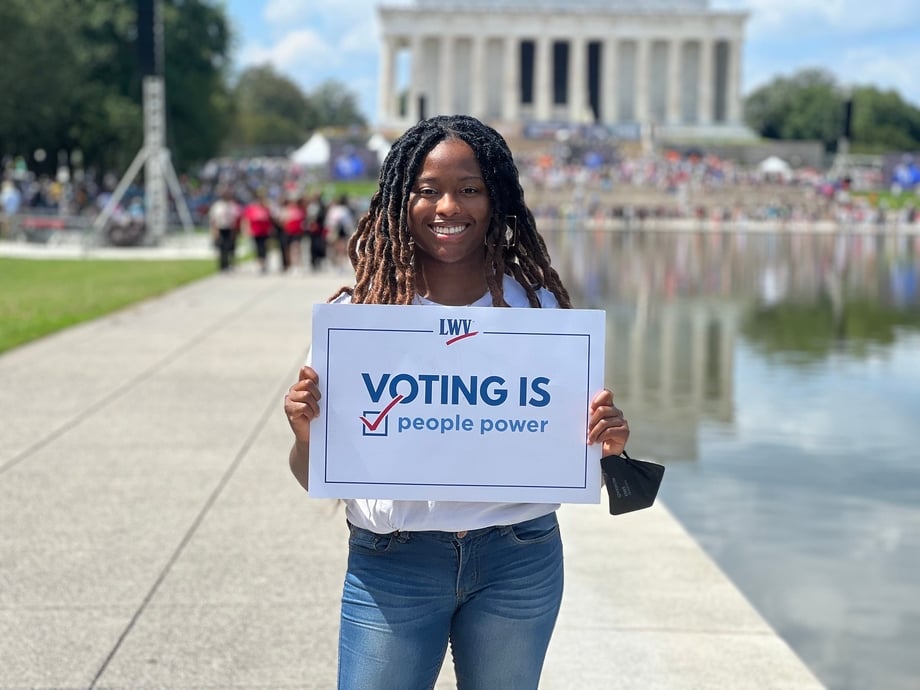
We must continue to honor Juneteenth, just as we must continue to remember all the civil and voting rights advocates that came before us. Attacks on Juneteenth and DEI aren’t simply attacks on “communities of color” ; they’re fractures to the core idea that our democracy is strengthened when more Americans can see themselves reflected in the story. And the longer a fracture remains untreated, the worse it gets, until the health of the entire democracy is at risk.
,
,
This work requires the knowledge and experience of people of color, but it also requires our white allies to use their privilege to stand up in the face of backsliding. Maybe this looks like advocating against book bans at your school council, buying groceries for families who risk safety because of being targeted by ICE, or attending protests to fight authoritarianism. It can involve donating directly to organizations that work with impacted populations or writing to your representatives about voting rights. History is not valuable because it tells us where we’ve been. It’s valuable because it teaches us what democracy can become.
Most of all, I urge you to consider the timeliness of the upcoming midterm elections. As I write, people across the nation are heading out to cast their ballots in primary elections. Juneteenth is a reminder that every expansion of American democracy has required people who were willing to participate, even when the outcome was uncertain. We have a golden opportunity to make our voices heard and ensure that the people put in power are those who will fight for us.
Make Your Plan to Vote with VOTE411!
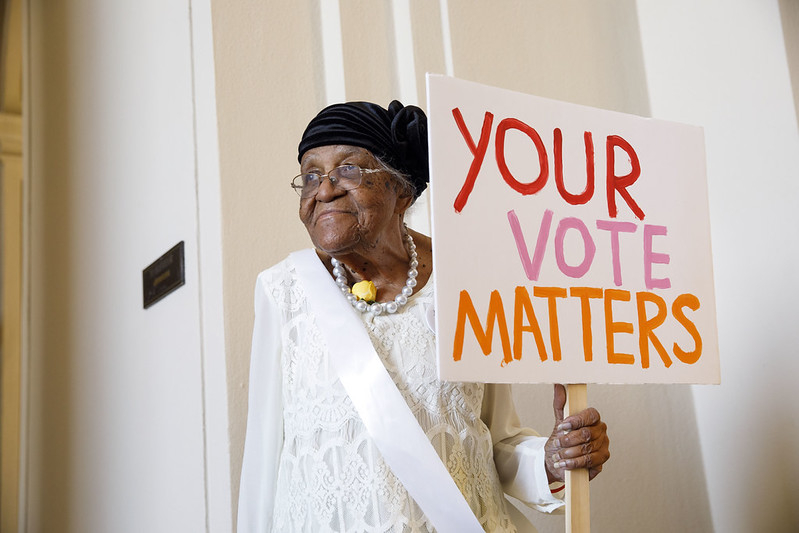
If you have ever wondered whether your vote matters, remember this: rights that hold no power are rarely challenged. We must make our voices heard at the ballot box. Democracy has never been sustained by spectators. It has always depended on ordinary people choosing to act.
Find your voting information at VOTE411.org, our one-stop-shop for election information in English and Spanish. Make sure you’re registered, check your local voting rules, and mark your next election on the calendar. We can’t afford to sit this one out.
,
,
I don’t know where we’ll be next Juneteenth. I won’t lie, there are moments when I feel uncertainty — even fear. But then I think of the people of Galveston, who did not know what freedom would require of them, only that it was worth pursuing. And it reminds me of something even more important: the future isn’t written either. That has always been the promise, and the responsibility, of democracy.
Our power is in joining together, speaking up against injustices, and being relentless about the fight.