Natural Resources Committee
Natural Resources Committee
Peggy Gilges, Director 2024-2026
The Natural Resources Committee (NRC) monitors and speaks out on local environmental issues as stated in the LWV CVA Local Positions.
The Charlottesville area has a lot of activities going on that affect our environment. The Natural Resources Committee tries to stay on top of the action, keeping LWV-CVA members informed. We consider the full costs of economic development, the significance of local elections, issues that should be addressed through government policy, like the spreading of PFAS-contaminated sewage sludge on local farmland, and the impacts of the Virginia data center boom on our climate, land, water and quality of life. We also educate about and advocate for policies that benefit us all by supporting our shared environment, such as riparian buffers, conservation mowing, and dark skies.
The Natural Resources Committee meets (usually on zoom) on the fourth Monday of each month, from 4 to 6 pm. Contact peggygilges [at] me.com for further information.
Take action for our environment this fall!
Topics We're Keeping An Eye On Right Now...
Biosolids, Conservation Mowing
Policy and Practice Changes For Applying Treated Sewage Sludge to Farmland
In June 2026, LWV-CVA hosted a presentation by Stuart Overbey of Don't Spread On Me, a grassroots organization formed to raise awareness about the risks of spreading sewage sludge. Now, public comments to the Virginia Department of Environmental Quality (DEQ) are being accepted until September 24 on Synagro’s permit application for spreading sewage sludge in Albemarle.
The NRC recommends using Don't Spread On Me's website to make and submit an effective comment.
Alternatively, Wild Virginia will host a comment-writing party via zoom on September 17th for those interested in submitting a comment.
Supporting Biodiversity with Conservation Mowing on Our Public Lands
By Christine Hirsh-Putnam, Natural Resources Committee
Last winter the landscape was covered with a layer of icy snow, which made walking even a short distance quite treacherous. Wildlife also struggled to contend with these conditions. Let me share a tale of two landscapes: the mowed and the unmowed. Although the temperatures stayed near freezing during the day, the snow covering the mowed grass became more like a skating rink with an impenetrable layer of ice. In the unmowed landscape, the stems and stalks of dead grasses and forbs poking out of the snow absorbed the sunlight, helping to melt small wells in the snow along the base of the plants. This unmowed landscape was a boon for birds and small mammals, giving them access to seeds and shelter. It was also a place of beauty, not only in the winter but also throughout the year, especially in the summer and fall. We can use conservation mowing to transform the ecological desert of the mowed landscape into a landscape that supports ecological diversity.
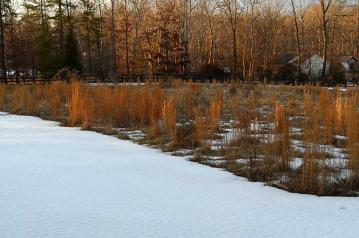
(Photo by Karen Rexrode)
The good news is that conservation mowing is being implemented in some of our Albemarle County parks and on many of our public school campuses. Conservation mowing maintains the open space by mowing once a year in the late winter. This practice is being used in places where it is difficult to mow, such as steep slopes and areas that are not regularly trafficked by people.
Conservation mowing provides a myriad of benefits:
- Supporting biodiversity by providing habitat for insects, birds, turtles, and small mammals. In Virginia, grasslands support over 60 species of birds, many of which are facing steep population declines due to habitat loss.
- Improving the health of our waterways by slowing stormwater runoff and improving water infiltration into the soil. This can reduce flood risks and reduce pollutants in our waterways.
- Reducing carbon emissions and noise pollution from gas-powered landscaping equipment.
- Saving money by reducing fuel, labor and equipment maintenance costs.
- Improving employee safety by reducing the amount of hours spent mowing steep slopes.
I invite you to visit one of the County's conservation mowing areas this summer. There is a particularly nice one in Darden Towe Park, up the hill from the parking lot along the Rivanna River. Take a minute to listen to the hum of insects and look for the flitting of birds. If you like what you see, please let the following decision makers know you support conservation mowing on our public lands. Raise your voice to support biodiversity!
Albemarle County Board of Supervisors (bos [at] albemarle.org)
Amy Smith, Director of Parks and Recreation (asmith [at] albemarle.org)
Albemarle County School Board (schoolboard [at] k12albemarle.org)
Read more about conservation mowing: