By Martha Davis, Elizabeth Sala, and Anne Omsted
Water equity in California is grounded in the principle that all people have the right to safe, clean, affordable, and accessible water for human consumption, cooking and sanitary purposes regardless of income, race, geography, or other factors. The human right to water extends to all Californians, including disadvantaged individuals and groups and communities in rural and urban areas.
In fact, California was the first state in the nation to legislatively recognize a "human right to water" when in 2012 it passed Assembly Bill (AB) 685. This was followed in 2016 by a State Board Resolution pledging that it would work to "preserve, enhance, and restore the quality of California's water resources and drinking water for the protection of the environment, public health, and all beneficial uses."
To understand the significance of California's water equity policy, imagine turning on your tap and NO water comes out - or worse, it is brown and stinks - but you still have to pay your monthly water bill even if your water is undrinkable, unusable, and unsafe.
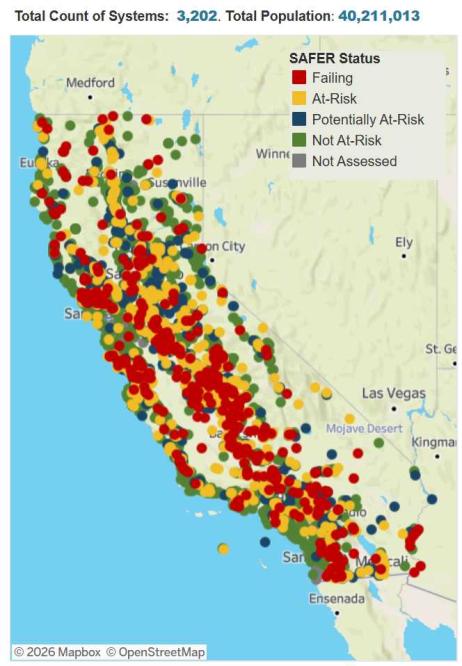
This is the reality that faced an estimated 1.6 million California families in 2019 according to research conducted by the State Water Resources Control Board. Today, the State Water Board data shows that NO region of California remains untouched by this problem. There are families near all of us who still lack access to safe, clean, and affordable water.
Water Systems in California and their 2025 SAFER Status
How California is Addressing the Water Equity Challenge
Faced with these statistics, California launched a funding program in 2019 called SAFER -California's Safe and Affordable Funding for Equity and Resilience. In the short term, SAFER was designed to ensure that residents who didn't have safe, adequate and affordable drinking water could receive it as soon as possible - even if this meant delivering bottled water to them as an emergency stopgap measure. In the long term, the SAFER program has identified and is funding sustainable solutions to failing water systems to ensure these systems are modernized and can produce safe, usable water. For water systems that could not be fixed, the Board has worked to consolidate these service areas with ones that can provide clean, affordable water.
Currently the SAFER program guarantees up to $130 million annually will be made available through 2030. This funding is paying for needed operations, maintenance, and other improvements for at-risk and failing water systems along with providing replacement water to impacted homes. The SAFER program has made a huge difference in the lives of many Californians who finally have access to safe and affordable drinking water. SAFER's achievements as of 2024 include:
- 321 systems are no longer on the State's "failing list", benefiting over 3.3 million customers
- $540 million in construction and planning assistance was provided to small systems
- 170 system consolidations have been completed, providing safe water to over 324,000
- 861 water systems benefit from SAFER staff support
- $124M provided in technical and administration operations
- Kristyn Abhold, an official in the SWP Financial Assistance Division, said the program has spent about $128 million on construction projects and drilled 103 new wells since July 2025
Even with all the accomplishments listed above, about 600,000 people still get water from systems that state regulators say are failing to meet safe drinking water standards.
But California's water equity problems can't be solved by SAFER alone. The state has also advanced water equity by dedicating a majority of its State Water Board infrastructure funding - roughly $5.2 billion over a recent three-year stretch - to drinking water, wastewater, and stormwater projects in disadvantaged and rural communities. In addition, almost two-thirds of the State Board's financial assistance is distributed directly as grants for drinking water and wastewater projects in disadvantaged communities.
The state's policy initiatives target specific obstacles to achieving water equity. For example, the Racial Equity program requires state water policies and programs to be actively realigned to address racial injustices and to remove barriers to community access in local decisionmaking. In addition, the state continues to push for legislative and policy reforms, such as the bold water reforms to establish permanent statewide low-income rate assistance to help ensure that water remains affordable for low-income families.
Issues Before the California Legislature
Advancing California's water equity requires continued commitment. Despite the State's record of success there are two key legislative initiatives that merit our support:
- Protect SAFER Funding.
The legislative promise that the funding for the SAFER program would extend through 2030 is now in jeopardy. This spring, the Cap-and-Trade program -the current funding source for SAFER - was restructured by Governor Gavin Newsom and lawmakers. The new program, now called "Cap and Invest", removed the 2030 expiration date for the SAFER program, theoretically extending its lifespan. However, the legislation also eliminated the safety-net promise that required California's General Fund to cover any revenue shortfalls from carbon credit auctions under the new Cap and Invest program. This policy shift makes safe drinking water a lower funding priority relative to other projects. According to the State Department of Finance, SAFER could lose as much as $100 million in funding through 2030. - Advance the State's Low Income Water Rate Assistance Framework - SB 1125.
Introduced by Senator Caroline Menjivar, this Senate Bill would lead to the establishment of California's first statewide Low-Income Water Rate Assistance Program. The legislation directs the State Water Board to develop an annual drinking water needs assessment and a framework to reduce utility costs for qualifying low-income households.
In early June, Governor Newsom began planning to fund the SAFER program at $68 million. Negotiations are underway between the Governor, Senate and Assembly to address the final plan. What are the consequences if funding for SAFER is not reinstated? Here's what Kelsey Hinton, policy director for the nonprofit Community Water Center said: "If we only get the $68 million, it significantly puts at risk sustained funding for these projects. We are at risk of slowing down or stopping momentum on safe water solutions statewide, and that’s something that we can’t afford to stop."
This is an important matter that the League of Women Voters will continue to track.