By Satsie Veith, Leslie Leach, and Elizabeth Sala
As made clear in the first article in the Water Spotlight series, California’s Surface Water Development, struggle over water is part of California life. Many people and organizations have legal rights to water, and there is never enough to satisfy everyone. In the resulting conflicts, who stands for the interests of the public? Who protects the natural world? Part of the answer lies in an ancient legal principle known as the public trust doctrine. This article looks at important recent developments that have made this principle a more potent legal tool to protect our environment. This story begins with Mono Lake. In the 1970’s, this beautiful and biologically diverse saline lake on the east side of the Sierras was in desperate trouble. The Los Angeles Department of Water and Power (LADWP) had just installed a new aqueduct to carry water from the streams and creeks that fed the lake to the southern metropolis. Lake levels sank, the water grew saltier, nesting birds were no longer protected from predators. The ecosystem was near collapse. The California State Water Resources Control Board (Water Board) said it could do nothing to stop the flow down the aqueduct because Los Angeles had water rights.
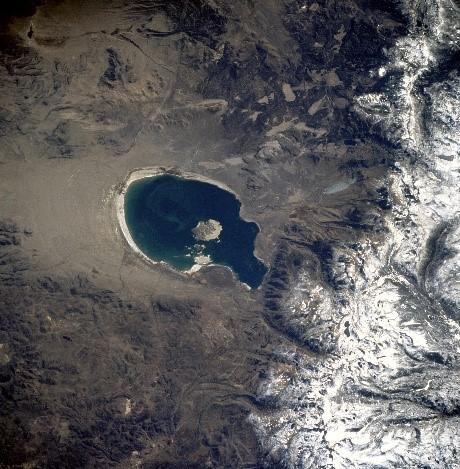
NASA satellite photo of Mono Lake in 1985, showing drop in lake level (public domain)
In 1978, concerned citizens formed the Mono Lake Committee to save the lake. Along with the Audubon Society and others, the Committee filed a lawsuit in which they argued that the public trust doctrine required the Water Board, despite the water rights held by LADWP, to step in and prevent water levels at Mono Lake from falling to a point that would cause the loss of this essential “terminal lake”. The courts agreed. The resulting California Supreme Court decision, National Audubon Society v. Superior Court (1983), is a landmark case in environmental law.
What is the public trust doctrine?
Crucial to the outcome of the Mono Lake case was the public trust doctrine. First articulated in the laws of the Roman Emperor Justinian and carried into British law and then to the United States, this doctrine establishes a right of access by the public to certain bodies of water, such as coasts and navigable streams and rivers. Under the doctrine, the government acts as trustee to protect the public’s right. It has existed in CA law since the state was formed in 1850 and can be found in several statutes of the CA Water Code (such as Cal. Water Code § 100) and in Cal. Constitution article X §§ 3 and 4.
The Audubon decision extended the doctrine to the protection of natural resources, including non-navigable tributaries such as those that feed Mono Lake, and underscored that the state has an affirmative duty to make sure water rights are not used wastefully and harmfully.
What has happened since Audubon was decided?
While the Mono Lake ecosystem has been saved from collapse, it is a long way from being fully restored. In 1994, the Water Board issued an order amending LADWP’s water rights and stating that it must decrease water transfers to allow the lake to rise to at least 6392 feet above sea level. Progress has been made, but that goal has never been met. The matter continues to be debated at Water Board hearings.
As the implications of the Audubon case have been absorbed, more cases invoking the government’s role as steward of the public trust have been heard in California courts. In a case involving events at the northern end of the state, groundwater pumping by farmers along the Scott River Valley in Siskiyou County caused the level of the Scott River to fall dramatically and even dry up on occasion. This had a devastating effect on the Scott River’s salmon fishery and on recreational use of the river. The county agency that issued the pumping permits refused to remedy this situation.
Environmental groups filed a lawsuit claiming that the Water Board and Siskiyou County were responsible under the public trust doctrine for preventing this level of damage to the river, even though in this case it was groundwater, not surface water, withdrawal that was causing the damage. The court agreed. This decision enlarged the reach of the public trust doctrine by establishing that aquifers can be protected if excessive pumping can be connected to loss of natural resources or recreational sites. In 2015, three advocacy groups filed a lawsuit against the Water Board claiming that it had failed to honor the public trust doctrine in its management of the Sacramento River and San Francisco Bay/Delta. They alleged that the Water Board had failed to manage temperature levels in the Sacramento River and ensure that fish below dams are maintained in good condition (also required by Cal. Fish & Game Code § 5937), thus endangering fish species in the river and the delta. The resulting settlement required, among other things, that the Water Board be transparent in the public trust doctrine factors it will consider when judging whether Bay-Delta plans will protect fish and wildlife.

A fish fights its way upstream (public domain)
The bottom line.
These, and other, cases represent progress in the legal recognition of the public interest in water issues and particularly in protection of the natural world. It is also the case that this doctrine by itself does nothing without dedicated members of the public ready to insist that it be enforced.
That is in line with the League of Women Voters of California’s Water Position, which reads in brief: Support measures that promote the management and allocation of water resources in ways that respect the environment, with emphasis on conservation and high standards of water quality that are appropriate for the intended use.
The LWV California Water Interest Group began writing monthly Water Spotlight articles in April 2026. Their intent is to educate LWV members across California on the complex issues of water use. Topics will include historical, environmental, infrastructure and policy challenges as a foundation for actions LWV may want to take. Topics will focus on current LWV positions and beyond. The Water Spotlight will explore different aspects of this complicated situation and look at solutions. For questions please contact water [at] lwvc.org