The League of Women Voters of the Charleston Area, South Carolina (LWVCA) is concerned about declining childhood immunization rates in our area and statewide. Over the past several years, the rates of childhood immunization have declined while the rates of religious (non-medical) exemption have increased. This trend has harmful consequences for our children and other vulnerable populations. Vaccination protects children against measles, mumps, rubella (German measles), polio, diphtheria, tetanus, pertussis (whooping cough), varicella (chicken pox) and other diseases which can lead to long-term disease, disabilities, and death. There is extensive misinformation about immunizations. This is partially driving lower vaccination rates. Prevention measures like vaccinations contribute to healthy families. Healthy citizens are a part of a strong democracy.
In June 2026, we sent a * letter to school board trustees and superintendents in Charleston, Berkeley, and Dorchester expressing our concerns and including the following data. It is our hope that given the impact that declining vaccination rates and vaccine-preventable disease outbreaks can have on student health, continuity of learning, school operations, and the broader community, school board members will be strong advocates for vaccination policies that protect our children. The voices of our school board leaders will be impactful with state legislators, who have the authority to pass laws and regulations that reinforce best practices for children’s health. *Attached letter is to CCSD board members.
Vaccination Rates in Our Area
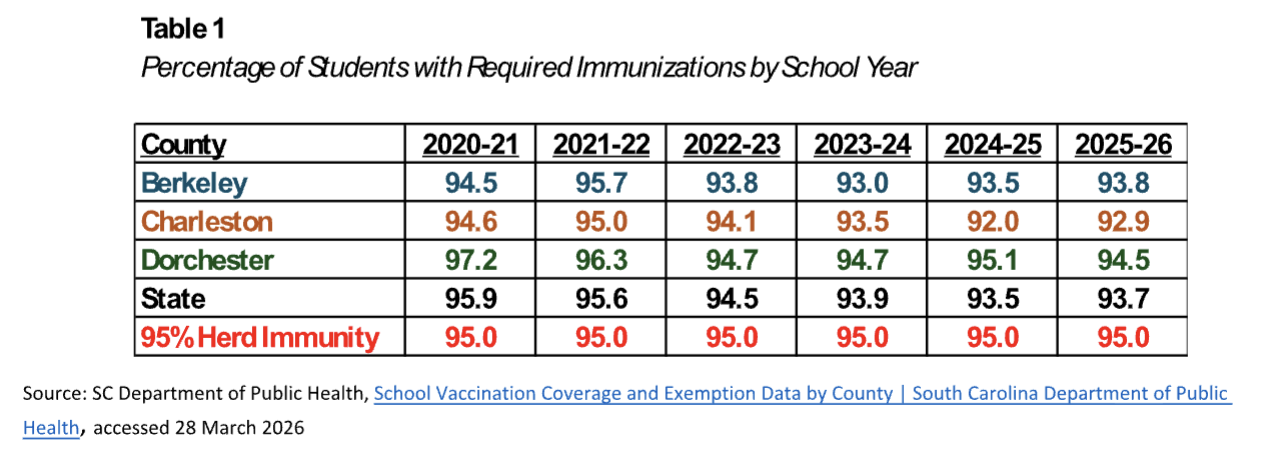
School vaccination rates in our area are declining. The percentages of students that have the immunizations required for school enrollment in Berkeley (blue), Charleston (orange), and Dorchester (green) counties are shown in Table 1 and Figure 1 below. For comparison, the State percentages (black) and the 95% herd immunity level (red) are also included. Ninety-five percent coverage provides herd immunity, offering protection for the community, and particularly for those individuals who are unable to receive vaccines due to medical reasons. For the 2025-26 school year, the percentages of immunized students in Berkeley, Charleston, and Dorchester counties are below the 95% herd immunity level.

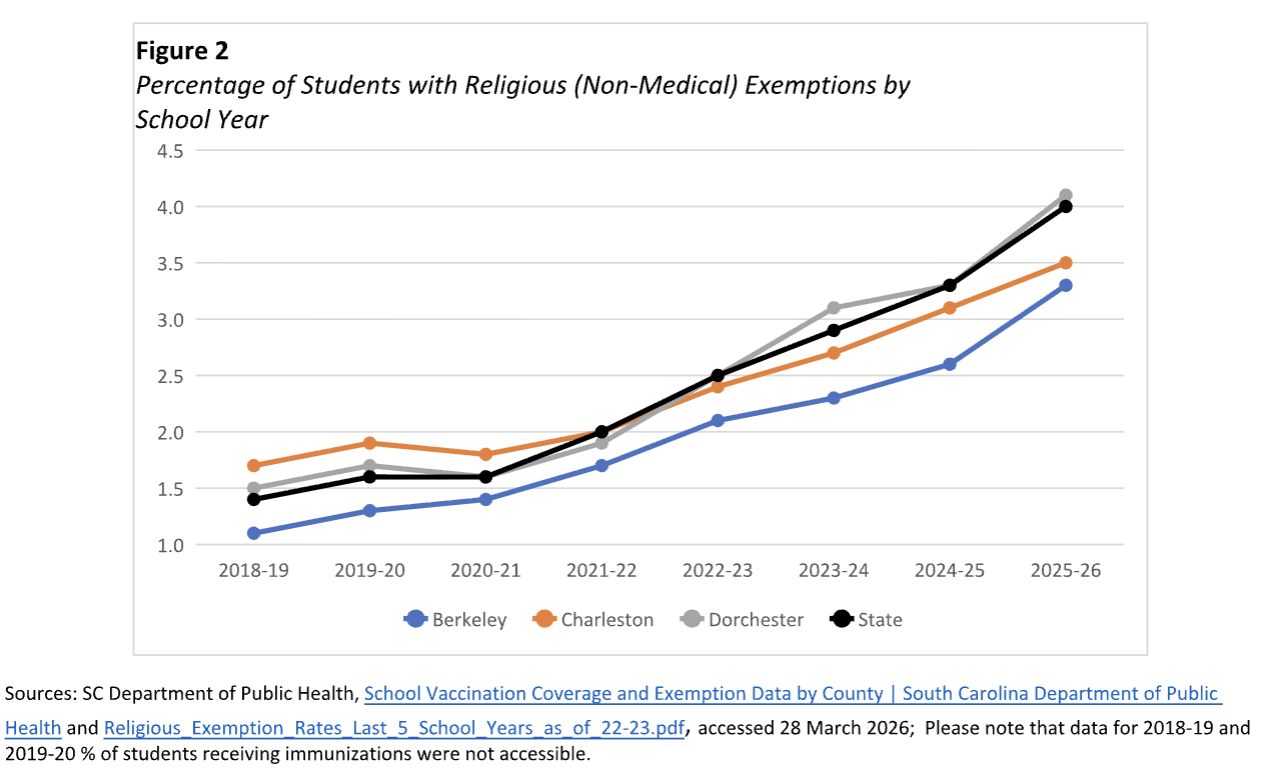
The rates of religious (non-medical) exemptions are increasing. Non-medical exemptions can be easily obtained by parents. The percentages of students that have religious (non-medical) exemptions and therefore are not required to receive the required immunizations in Berkeley (blue), Charleston (orange), and Dorchester (green) counties are shown in Table 2 and Figure 2 below. For comparison, the State percentages (black) are shown as well. The 2025-26 school year data continue to demonstrate a disturbing increase in non-medical exemptions.

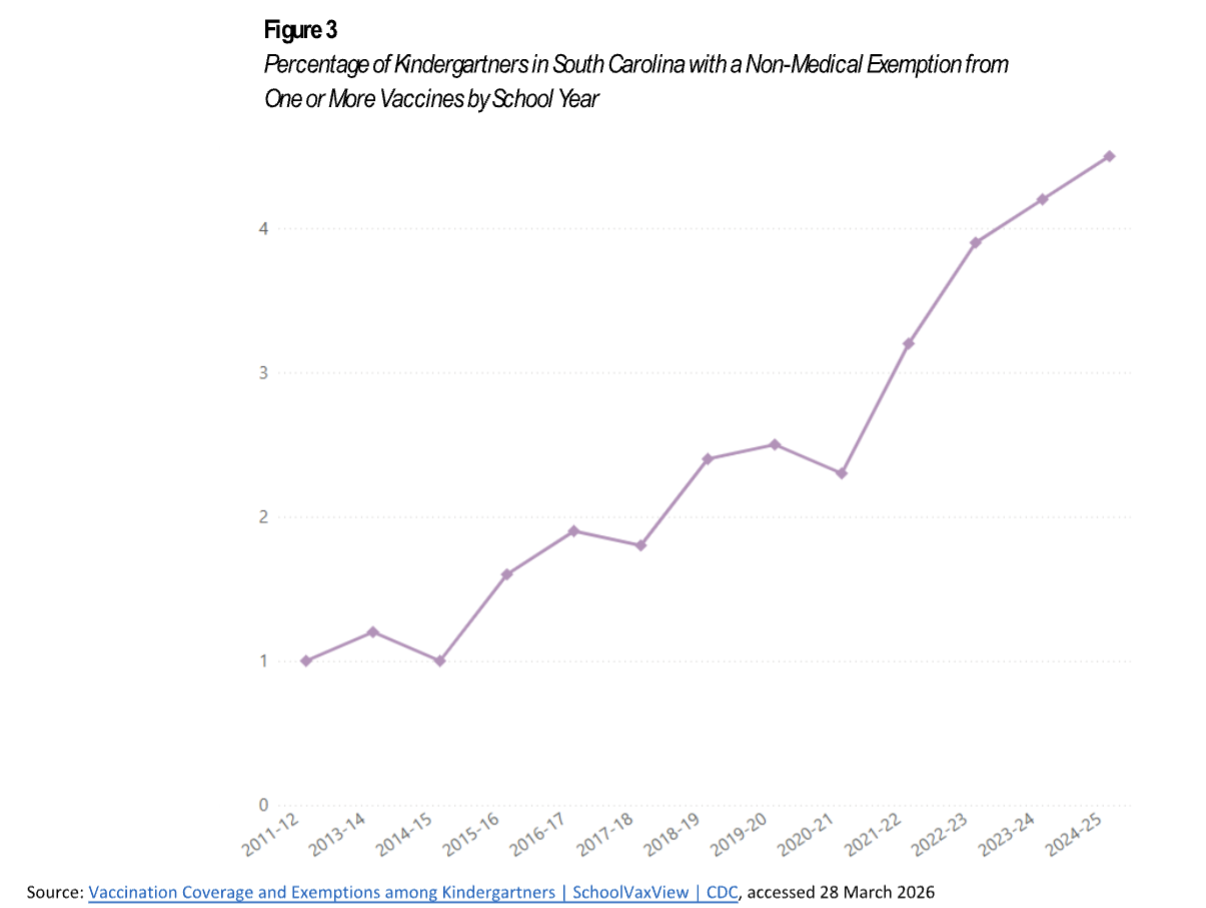
To provide a longer-term perspective, the percentage of South Carolina kindergartners with a non-medical exemption from one or more vaccines is shown in Figure 3 below. The percentage of non-medical exemptions has increased significantly.
Vaccination rates for each of our public and private schools are available at this website: 45_Day_Report_25-26_20260310.pdf The table includes the total number of students for each school. Home schooled students are not covered by the State’s immunization law. Home schooled students are not covered by the State’s immunization law. The State’s requirements do not apply to higher education institutions, which have their own policies.
To gain insight into the data, members of the LWVCA Healthcare Committee contacted State and local representatives of education and public health. Contacts with school representatives indicated the public schools have an established system in place to track immunization status and to notify parents of immunization issues. Notably, the Charleston County School District participates in the Vaccination for Children program which permits in-school vaccinations.
Some initial attempted contacts were not successful. Some resulted in referrals to the South Carolina Department of Public Health. Committee members were left with the impression that personnel were cautious about sharing information. The South Carolina measles outbreak received a great deal of media coverage, which has also provided insight to the committee.
More recently, communications with SC Families for Vaccines, the Southern Alliance for Public Health Leadership, and the SC Department of Public Health have provided valuable insights.
Reasons for Concern
In addition to the direct health impact on the children involved, there are several other reasons to be concerned about the decline in vaccination rates and the increase in non-medical exemption rates:
- There is a significant health, social, and financial impact on families impacted directly or indirectly by disease. Family members may be unable to work due to the need for care for their children. There may be additional medical expenses, particularly for uninsured and underinsured families.
- Students suffer a loss in learning when out of school, either for illness or for exposure to disease. School administrators, teachers and other staff must deal with student absences, alternative lesson plans, vaccination tracking, exposure to disease, and more.
- The public health care system and private providers expend resources and bear costs involved in tracking and dealing with exposures, hospital visits, and the diversion of resources from other endeavors.
- There is an increased risk of severe disease for infants too young to be vaccinated and the immunocompromised. The concept of herd (community) immunity means that these individuals are protected through high vaccination rates of other members of the community.
- Although difficult to quantify the total economic costs to families, schools, businesses, and government there are large and significant costs of a disease outbreak, costs which could be avoided with adequate vaccination levels.
Call To Action
The Healthcare Committee recognizes that any efforts to improve vaccination rates can be successful only in collaboration with community partners. A multi-tiered strategy is key. This includes education and legislation. Advocating for legislation with promotes public health and prevention, including vaccination, is an important priority for LWVCA.
School district board members play an important role in promoting and enabling high student vaccination rates. Through contacts with Healthcare Committee members, school board members in the Tricounty area are being asked to: routinely review their schools’ vaccination rate data to identify opportunities for improvement, ensure there is good communication to parents on the need for vaccinations, work to improve access to vaccinations provided in their schools and in their communities, and provide adequate resources to school personnel for this purpose. They are also being asked to advocate to legislators and other policy makers to enact laws and regulations that promote child safety through high vaccination rates.
The Committee continues to review vaccination rates and pertinent legislation, work with organizations such as SC Families for Vaccines and the Southern Alliance for Public Health Leadership, and advocate in relevant forums with the objective of improving vaccination rates.
Sources, current as of August 31, 2026:
2025 Measles Outbreak | South Carolina Department of Public Health
Measles Dashboard | South Carolina Department of Public Health
School Vaccination Coverage Data | South Carolina Department of Public Health
Religious_Exemption_Rates_Last_5_School_Years_as_of_22-23.pdf
45_Day_Report_25-26_20260310.pdf
Vaccination Coverage and Exemptions among Kindergartners | SchoolVaxView | CDC
Back-to-School Immunization Toolkit | South Carolina Department of Public Health
School-Law-Letter-2025-2026_20260320..pdf
Childhood Vaccine Exemption | South Carolina Department of Public Health