Advocate Using Facts You Can Trust

Advocate Using Facts You Can Trust

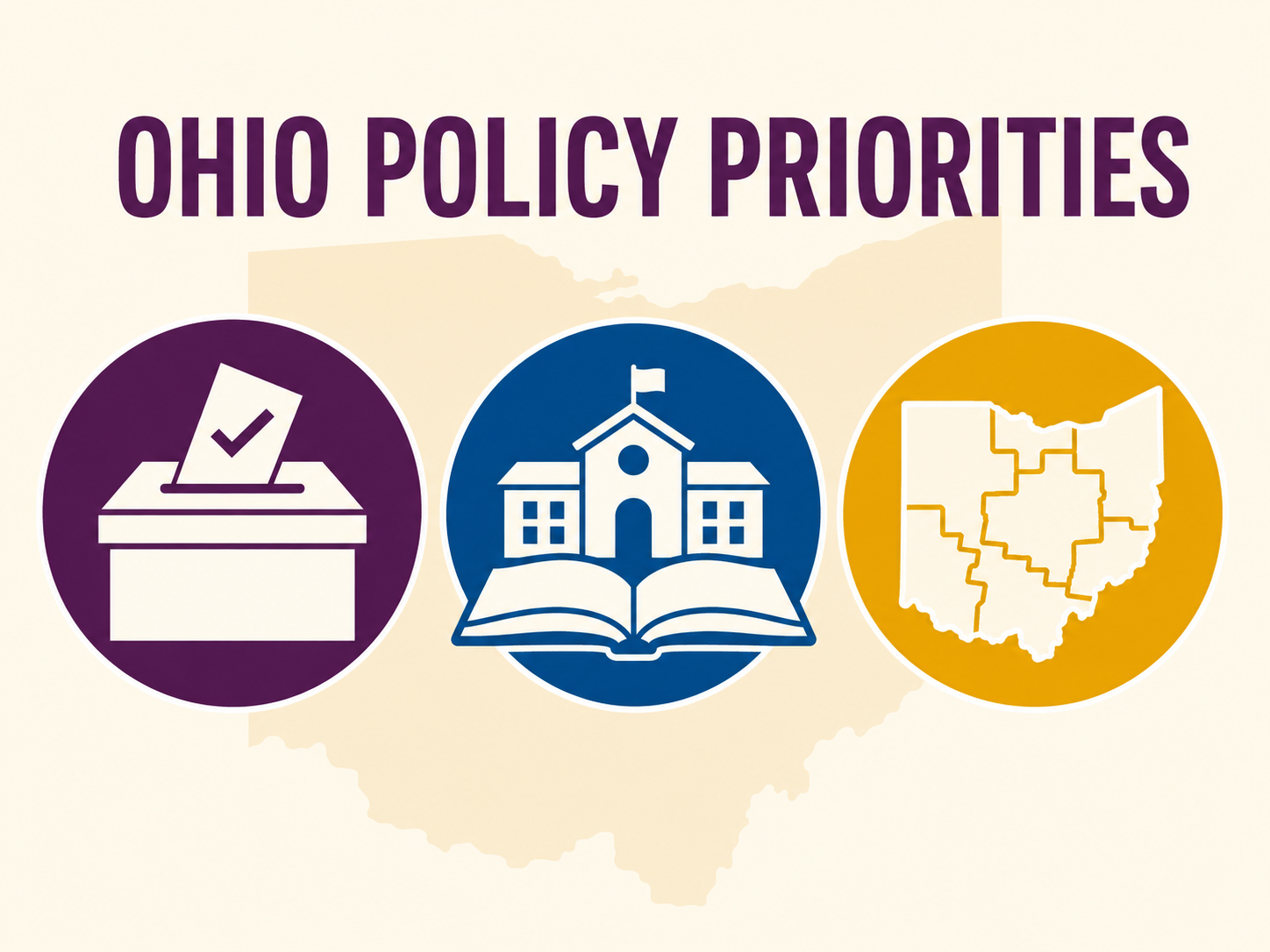
Ohio policy priorities: voting, public education and fair redistricting

1. Explore Current Policy Priorities

LWV Ohio works to strengthen democracy by protecting voting access and secure elections, supporting high-quality and honest public education, and advocating for fair legislative districts.

More on LWV Ohio’s Priorities

LWV Ohio Action Alerts

2. Make Your Voice Heard

The Action Alerts app makes it easy to advocate with Ohio lawmakers on public policy matters based on nonpartisan research. Use the app to stay informed and mobilize on critical issues.

Open Ohio Action Alerts

LWVMC Informed Voices Create Stronger Communities


Explainers: Informed Voices Build Strong Communities

Examine the causes and consequences of public policy so we can engage thoughtfully, advocate effectively, and strengthen democracy in Franklin County.


Fair Election Districts Matter

Find out how they help make sure voters choose their representatives, not the other way around.

When districts are drawn unfairly, map‑drawers can use tactics like packing voters of one group into a few districts or cracking them across many districts, which creates “safe” seats where election outcomes are decided before anyone votes. In these cases, many votes are wasted because they cannot change the result, and elections become less competitive. This weakens democracy by reducing voter power and making representatives more accountable to map designers than to the people they serve.

Fair districts are made by following clear, nonpartisan rules instead of political goals. These rules include giving each district about the same number of people, keeping neighborhoods and communities with shared needs together, and drawing districts that are connected and reasonably shaped. Fair map‑drawing also avoids using party data or protecting incumbents and is often done through transparent, public processes so voters can see how decisions are made. /p>Read more on LWV website'


Ohio's Constitutional Right to Quality Public Education

Strengthen public schools or expand alternative private systems with public funding?

Ohio’s Constitutional Responsibility

The issue is not whether families should have choices. The question is whether Ohio should keep expanding separate publicly funded charter and private systems, or first fully fund the public school system required by the Ohio Constitution.

Ohio Constitution, Article VI, Section 2: “The General Assembly shall make such provisions, by taxation, or otherwise, as... will secure a thorough and efficient system of common schools throughout the state.”

This requirement has shaped decades of debate over public school funding, educational equity, property tax reliance, voucher programs, charter schools, public accountability, and academic standards. In theDeRolphcases, the Ohio Supreme Court found Ohio’s school funding system unconstitutional because of unequal reliance on local property taxes and disparities in educational opportunity.See DeRolph cases

Types of Schools, Public Funds, Standards, and Oversight

Type of School Use of Public Funds
Traditional Public Schools

• Serve all students

• Provide transportation

• Support students with disabilities

• Support multilingual learners

• Provide meals, counseling, and safety services

Funded through state, local, and federal public dollars.

• Operate under elected school boards

• Follow public records laws

• Follow open meeting laws

• Operate under direct public financial oversight

Academic Standards

Required to administer state assessments and publish report card results.

Charter Schools / “Community Schools”

• Publicly funded

• Tuition-free

• Independently operated

• May be managed by nonprofit or private organizations

Receive public funding based largely on enrollment.

• Operate through authorizers/sponsors

• Transparency and governance requirements may differ from district schools

• Staffing and financial oversight may vary

Academic Standards

May be subject to state testing and performance requirements, though implementation varies.

Private Schools Receiving Vouchers

• Privately operated

• May receive public funding through vouchers

• Often have greater curricular flexibility

• May not be subject to the same enrollment obligations as public districts

May receive public funds through voucher programs.

• Public oversight is generally more limited

• Often not subject to all public transparency laws

• Governance structures differ from public districts

Academic Standards

May use different standards, assessments, or reporting systems than public schools.

Perspectives in the Debate

Public Education Support Perspective Concerns About Diversion of Public Funds
Many advocates, parents, and community leaders argue that Ohio's first responsibility is to maintain and strengthen public education statewide.

• Schools cannot improve outcomes without stable and equitable funding.

• Public education supports democracy, civic participation, and workforce development.

• The Fair School Funding Plan was designed to address long-standing inequities and constitutional concerns.

• Emphasizes equitable funding, transparency, accountability, statewide standards, and elected local governance.

Critics argue that Ohio is creating a publicly funded parallel school system without consistently better academic outcomes.

• Public dollars should carry comparable public accountability requirements.

• Public schools generally must administer state assessments, publish report cards, comply with open records laws, and operate under direct public oversight.

• Some charter and private schools receiving taxpayer funds may operate under different or less transparent standards.

• The debate centers on whether expanding alternatives diverts funding from Ohio's constitutional public education system.


Constitutional Crisis

Lorem ipsum dolor sit amet, consectetur adipiscing elit, sed do eiusmod tempor incididunt.

Lorem ipsum dolor sit amet, consectetur adipiscing elit. Sed do eiusmod tempor incididunt ut labore et dolore magna aliqua. Ut enim ad minim veniam, quis nostrud exercitation ullamco laboris.

Learn more


Immigration

Lorem ipsum dolor sit amet, consectetur adipiscing elit, sed do eiusmod tempor incididunt.

Lorem ipsum dolor sit amet, consectetur adipiscing elit. Sed do eiusmod tempor incididunt ut labore et dolore magna aliqua. Ut enim ad minim veniam, quis nostrud exercitation ullamco laboris.

Learn more


SAVE America Act

Lorem ipsum dolor sit amet, consectetur adipiscing elit, sed do eiusmod tempor incididunt.

Lorem ipsum dolor sit amet, consectetur adipiscing elit. Sed do eiusmod tempor incididunt ut labore et dolore magna aliqua. Ut enim ad minim veniam, quis nostrud exercitation ullamco laboris.

Learn more


Harnessing AI’s Power: Preserving Human Dignity, Opportunity, and Agency

Lorem ipsum dolor sit amet, consectetur adipiscing elit, sed do eiusmod tempor incididunt.

Lorem ipsum dolor sit amet, consectetur adipiscing elit. Sed do eiusmod tempor incididunt ut labore et dolore magna aliqua. Ut enim ad minim veniam, quis nostrud exercitation ullamco laboris.

Learn more

LWVMC Impact


How We Have an Impact Together

Principles, collaborations and achievements


The League of Women Voters (LWVUS) Advocates for Nonpartisan Studied Positions

LWVUS uses a federated, grassroots structure to advance policy through member-driven studies, consensus building and targeted advocacy.

We work across political lines and with partners and nongovernmental organizations to focus on solutions for urban, rural and suburban communities.

Impact on Issues


Want to Do More? Contact Policymakers

Facts matter. Personal experiences make them memorable. Share how an issue affects you, your family or your community.

Use the template to write in your own voice, find your elected officials and share your perspective.

Find your Ohio lawmakers


Combat Mis/Disinformation → Trust Matters

Explore the challenges of navigating misinformation, disinformation and malinformation in today’s democratic landscape.

Learn strategies voters can use to identify reliable information and safeguard democratic processes.

Watch the video


Everyday Democracy

LWVMC members are everyday superheroes who safeguard democracy and change lives one voter at a time.

These true stories highlight members who go beyond the ordinary because helping voters matters.

Read the stories


Tell Us What Affects You in Franklin County → Together We Can Make Democracy Work

Our advocacy research starts with you.

The League encourages informed and active participation in government, builds understanding of public policy issues and influences policy through education and advocacy.

Use this form to tell us what affects you

Committee Contact
Contact Name: 
Advocacy Coordinator
League to which this content belongs: 
Metropolitan Columbus

All Posts Related to this Committee

Committees

Event Recap: Immigration Law & Changing Policies — A Conversation with Attorney Robert H. Cohen
Hosted by LWVMC Advocacy & Education • November 13, 2025

Immigration attorney Robert H. Cohen, one of Ohio’s leading experts with more than 45 years of experience, for an eye-opening discussion on the U.S. immigration system and the rapid policy changes affecting families, workers, students, and refugees.

Panel

The Watchlist table highlights issues, proposals, or policies that the League of Women Voters is actively monitoring but not yet issuing action alerts on. These are typically bills, initiatives, or developments that could have significant impact to your lives and may eventually require member response.

Panel
Blog Post

Effective advocacy depends not just on thoughtful planning, but on closely watching how legislation really moves — in hearings, behind the scenes, and on the floor. LWVMC develops local actions relying on regular reports of legislative actions such as bills, budgets and ammendments LWVO Lobby Corps.

dipatch logo
News

Advocating for the bipartisan Fair School Funding Plan as an ammendment to the 2025 Budget Bill.

Position

Advocate a public education system, birth to 12th grade, that adequately funds local school districts.
Panel

Our public education system is at risk. The Ohio Budget Bill for FY 26 and FY27 will determine if the third phase of the Fair School Funding Plan required by law is adopted to meet the conditions for a truly improving public school syste. Advocate for the bipartisan Fair School Funding Plan as an ammendment to the 2025 Budget Bill.

Panel

We talk a lot about the dangers of mis & dis information, especially as it relates to elections. But, what is mis & dis information? View Panel Video https://www.facebook.com/share/v/1CGgJFGhT4/