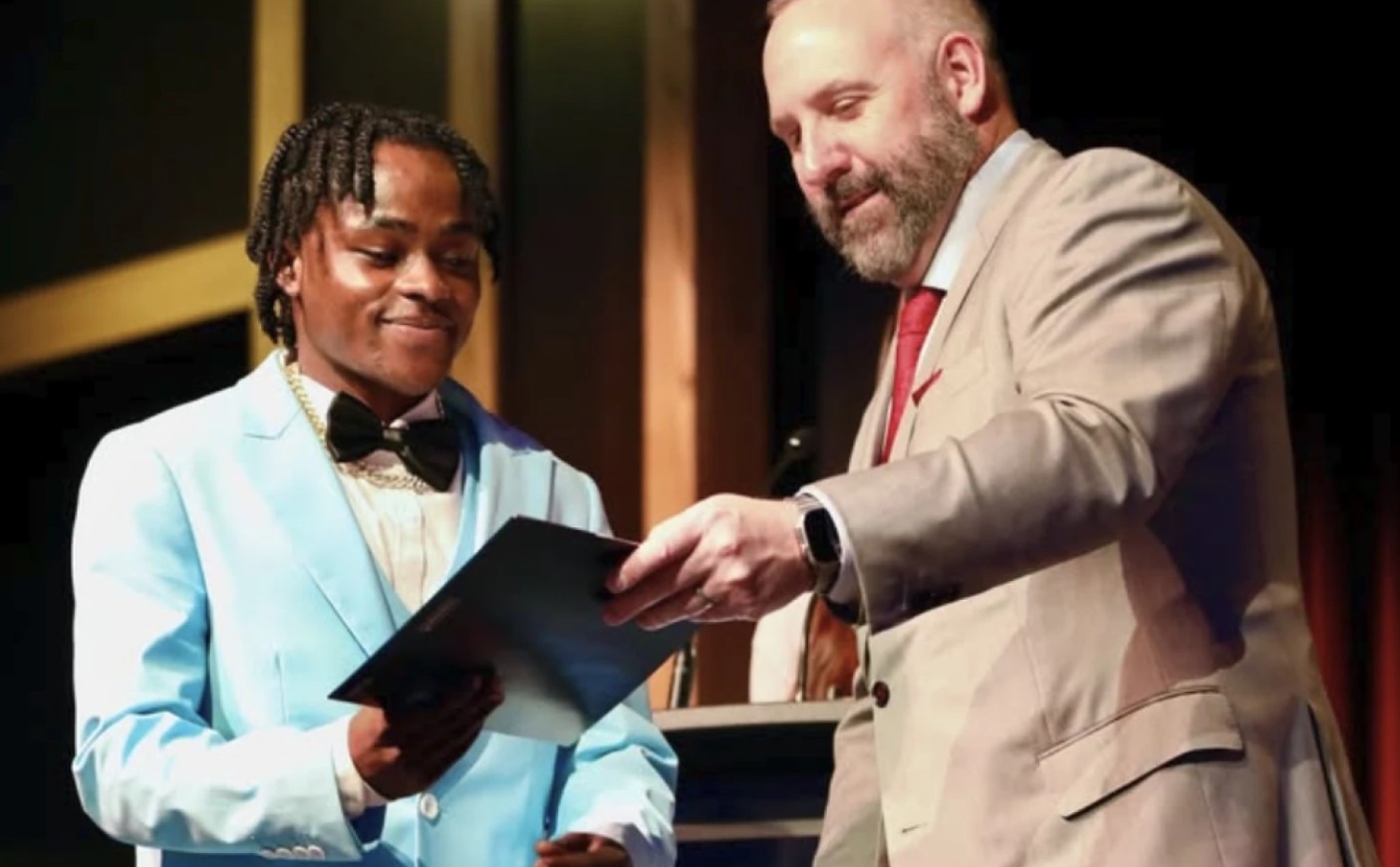
(Above image from WOSU.ORG, read full story there)
Unite and Rise: Marching for Peace

Marching for peace should threaten no one.
Peace is rooted in something we all share: the desire to live without fear, to reduce anxiety in our families and communities, and to resolve conflict without inflicting further harm. Yet calls for peace can sometimes feel threatening because politics often divides. A saying often attributed to Mahatma Gandhi reminds us that “an eye for an eye” ultimately leaves everyone blind.
At five o’clock on Saturday Sept. 5th morning, during my first check of email, I noticed an invitation from Cheryl Roller, vice president of the League of Women Voters of Metropolitan Columbus. Cheryl asked whether I would go with her to Springfield, Ohio, to join a Peace Walk organized by Indivisible Springfield and she would pick me up in a couple of hours. I said yes!
The walk had been planned before the death of Pierre Damas Bel, but organizers rededicated it to his memory and his family. On September 5, hundreds of people gathered in Springfield for the two-mile walk. Cheryl and I joined them.
Pierre was a 20-year-old Haitian immigrant, honors graduate, soccer player and ROTC student who had recently begun attending Wright State University. He had arrived in the United States from Haiti in 2024 and on a trajectory building a promising future through education and discipline.
After Pierre’s immigration protection was withdrawn, immigration authorities required him to wear a GPS ankle monitor. Pierre wrote publicly about the shame and humiliation he experienced. He explained that he had come to this country to pursue an education and build a better life—not to harm anyone or commit a crime. He wondered how he could participate in college sports while wearing a monitoring device.
On August 31, Pierre died after being struck by a truck on Interstate 70. His family believes that his death was a suicide and that the emotional distress associated with his immigration situation and the ankle monitor contributed to it. The official investigation was still pending when reports were published, so it is important to distinguish the family’s account from an official determination.
When I learned what had happened to Pierre, my response was personal as well as civic.
I came to the United States as part of the first major wave of Asian immigrants admitted after the country dismantled its discriminatory national-origins quota system. The Immigration Act of 1924 had established quotas favoring some European countries and had excluded immigrants from Asia. The Immigration and Nationality Act of 1965 abolished that system and opened possibilities that earlier generations of Asian families had been denied.
My family was among those who came through that newly opened door.
My father held two doctorates—one from Cambridge and another earned under the guidance of an Indian Nobel laureate. My mother was among the early generation of Indian women to receive a degree in physics. In time, they became proud naturalized American citizens. Together, they taught more than 7,000 students, sharing their knowledge of Mathematics and Physics and contributing to the country that had welcomed them.
I cannot imagine either of my parents being required to wear an ankle monitor simply because their immigration status had changed. The thought is horrifying. It would have publicly marked them as suspicious despite their scholarship, teaching, service and commitment to their adopted country.
That is why I felt such deep revulsion when I learned what had been done to Pierre. A monitoring device is not merely an administrative instrument when it is attached to a human being. It becomes a visible badge of suspicion—one that affects how an innocent person is treated by classmates, teammates, teachers, employers and strangers. This is devastating to someone who has high aspirations and principles.
Pierre was at the beginning of his adult life. None of us can know exactly what his future would have held. But we do know what he had already demonstrated: academic achievement, athletic ability, personal discipline and a desire to contribute. Those qualities suggest a young person with much to offer his community and his new country.
My parents’ lives taught me that immigrants should not be understood only in terms of what they receive from America. They also teach, discover, build, heal, serve and strengthen the nation. Their contributions may unfold across decades and touch thousands of lives. When fear and humiliation interrupt a young person’s path, we may lose possibilities whose value can never be measured.
The Peace Walk gave Cheryl and me a way to respond—not with anger or retaliation, but by standing alongside others.
Participants were asked not to bring their own signs. Organizers provided a limited number of signs and emphasized that everyone should remain peaceful, lawful and prepared to de-escalate any confrontation. That discipline mattered. Peace is not passivity. It is a deliberate choice about how we respond to suffering and injustice.
As we walked through Springfield, we joined people whose backgrounds and experiences may have differed from our own. We did not need to agree on every question of public policy to recognize Pierre’s humanity or to express compassion for a grieving family.
That, to me, is what it means to unite and rise.
We unite when we refuse to let fear erase our recognition of one another. We rise when we answer humiliation with dignity, isolation with community and despair with visible solidarity. We rise when we insist that public systems consider not only procedures and enforcement objectives, but also their consequences for actual human beings.
A peace march does not solve every problem. It cannot restore a young life or remove a family’s grief. But it can bear witness. It can tell a community that it is not alone. It can remind public officials that policies reach beyond statutes, court decisions and government forms. They enter classrooms, playing fields, workplaces and homes. They shape how people see themselves and whether they believe they still have a future.
Cheryl and I went to Springfield hoping to offer a small measure of peace. What I carried away was a renewed conviction: our democracy becomes stronger when we see one another not as categories, threats or political symbols, but as people.
Pierre Damas Bel came to America seeking an education and a future. His life should be remembered for that hope. His death should ask something of us: that we look carefully at the human effects of our public decisions, that we resist policies or practices that impose needless humiliation, and that we make compassion part of our civic life.
We marched because peace threatens no one.
We marched because dignity belongs to everyone.
We marched because, even in grief, we can unite—and rise.
Written by Jay Ramanathan, LWVMC member.
I used Chat GPT to organize content I provided and to create the graphic.