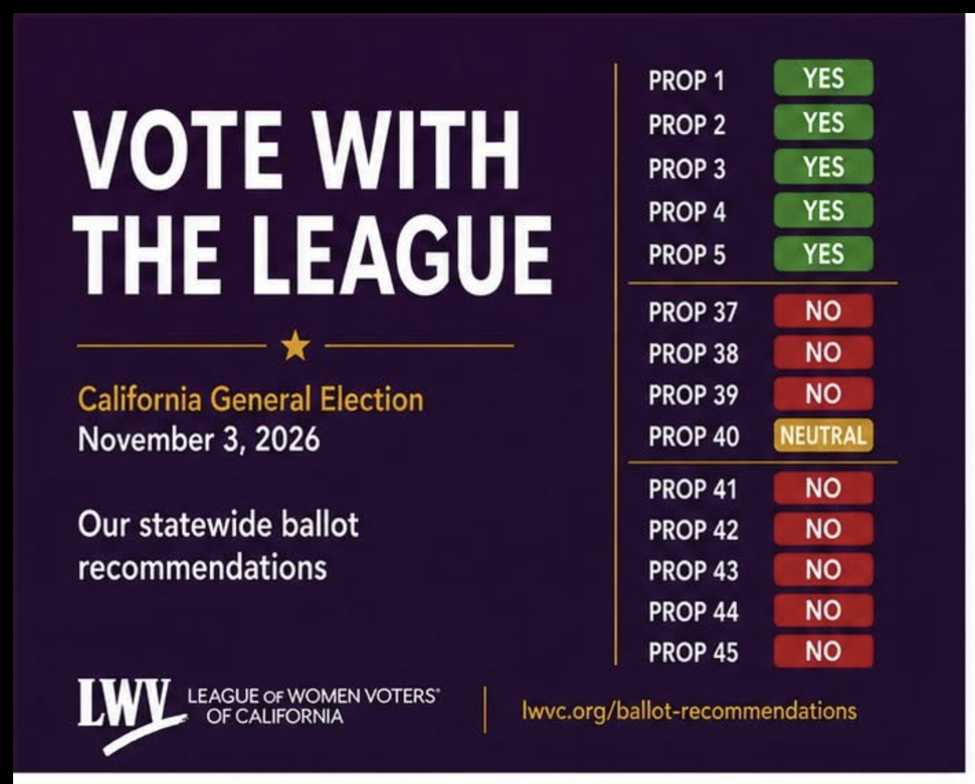
Each election, the League of Women Voters of California analyzes all statewide ballot measures and makes recommendations for voters based on our positions. We call this Vote with the League!
For more detailed information, see Vote with the League on the LWVC site!
- YES on 1, 2, 3, 4, 5
- NO on 37, 38, 39, 41, 42, 43, 44, 45
- NEUTRAL on 40
Download one-page Vote with the League flyer!
Authorizes $10 billion in bonds for affordable housing construction, preservation, and homeownership programs, plus $1.25 billion for CalVet home loans expected to be repaid by borrowers. California's earlier affordable housing bond funds are spent while projects remain stalled, and housing costs continue to drive homelessness and overcrowding.
Allows California to save more during strong economic years by building a larger rainy-day fund and requiring more savings when capital gains taxes are unusually high. Stronger reserves can protect schools and other essential services and reduce emergency borrowing when revenues fall.
Keeps California's current income tax rates on the highest-income 2 percent of taxpayers after 2030. Without Prop 3, those rates would fall in 2031, reducing state revenue by an estimated $5 billion to $15 billion a year. Prop 3 does not raise anyone's tax rate today.
Lifts California's near-total ban on public campaign financing and lets state and local governments create voluntary programs. Prop 4 creates no program and spends no money by itself. Public financing can amplify small donors, broaden who can run, and reduce dependence on wealthy donors, with safeguards on public funds and stronger penalties for illegal foreign money. The LWVC is an official proponent.
Prop 5 ends a system that can hand office to a replacement supported by only a small plurality. If a recall succeeds, the vacancy is filled under existing rules. For Governor, the Lieutenant Governor serves as Governor and, if the recall occurs early enough, voters elect a successor at the next statewide election. The LWVC is an official proponent.
Prop 37 addresses a real down-payment barrier, but with another mortgage that buyers generally would repay monthly on terms voters would not know in advance. It could reinforce racial and economic gaps: it gives no priority to first-time or first-generation buyers, could assist households earning more than $300,000 in some areas, and still requires at least 3 percent down. Assistance is limited to new or converted homes with no requirement that they be near jobs, transit, schools, or services. The Legislative Analyst says it is uncertain whether the program would result in more homes being built or purchased.
Medical research saves lives, but bonds are a poor way to fund it. Prop 38 would borrow $8.4 billion, requiring $500 million to $600 million in General Fund payments each year for about 20 years, about 10 percent more after inflation than paying up front. It would also lock billions into one field as other research needs emerge. Finally, California's stem-cell bond experience shows that royalties may do little to offset the debt.
Prop 39 is a Trump-inspired partisan power grab built on false claims about California elections. It would require government-issued ID every time someone votes in person and make mail voters put the last four digits of a designated ID number on the ballot envelope. California already verifies voter identity. Prop 39 would add barriers to voting, expose sensitive information to identity theft, force rejections of valid ballots for clerical mismatches, rely on flawed citizenship data, and cost up to hundreds of millions yearly. The LWVC is an official opponent.
Federal budget cuts threaten Medi-Cal and food assistance for millions of Californians. Prop 40 would impose a one-time tax of up to 5 percent on billionaire wealth, directing most of the money to health care. It could raise tens of billions and advance League goals on basic needs and tax equity. But onetime, earmarked funding is not a stable long-term solution, the tax relies on only a few hundred people, and its timing and revenue effects are uncertain. Strong League positions point both ways, so the LWVC is neutral.
Makes revenue from new state taxes enacted or taking effect on or after January 1, 2026, count toward the Gann Limit's constitutional spending cap and requires audits of programs funded by new or increased special taxes. It could prevent the state from raising or spending all the money voters authorize for public priorities and would reduce its ability to respond to changing needs.
Constitutionally prohibits new state taxes on the ownership or control of a broad range of personal property, including stocks, business interests, art, intellectual property, retirement accounts, and other savings and assets. It also limits certain retroactive taxes. The League opposes locking away future revenue options that California may need under different economic or fiscal conditions. PROP 43 Two-Thirds Vote for Certain Local Taxes OPPOSE Requires a two-thirds vote for new, increased, or extended local special taxes proposed by voters through the initiative process. That would let a minority of voters block tax measures supported by most voters and make it harder for communities to raise revenue when local needs or economic conditions change.
Requires affected nonprofit safety-net clinics to spend at least 90 percent of annual revenue on health care services or face substantial penalties. This rigid rule could force clinics to cut services or close, shifting patients to other safety-net providers and increasing public costs.
Share Vote with the League with your family and friends!
- Vote with the League: Ballot Recommendations (PDF)
- Vote with the League: Quick Reference Guide (Two-page summary of our ballot recommendations)
- Vote with the League: A Deep Dive on Ballot Recommendations (Detailed analysis & explanation of recommendations)
Looking for more information about the 2026 Ballot Measures?
Pros & Cons, a nonpartisan explanation of state propositions, with supporting and opposing arguments.
VOTE411.org to look up your personalized ballot.