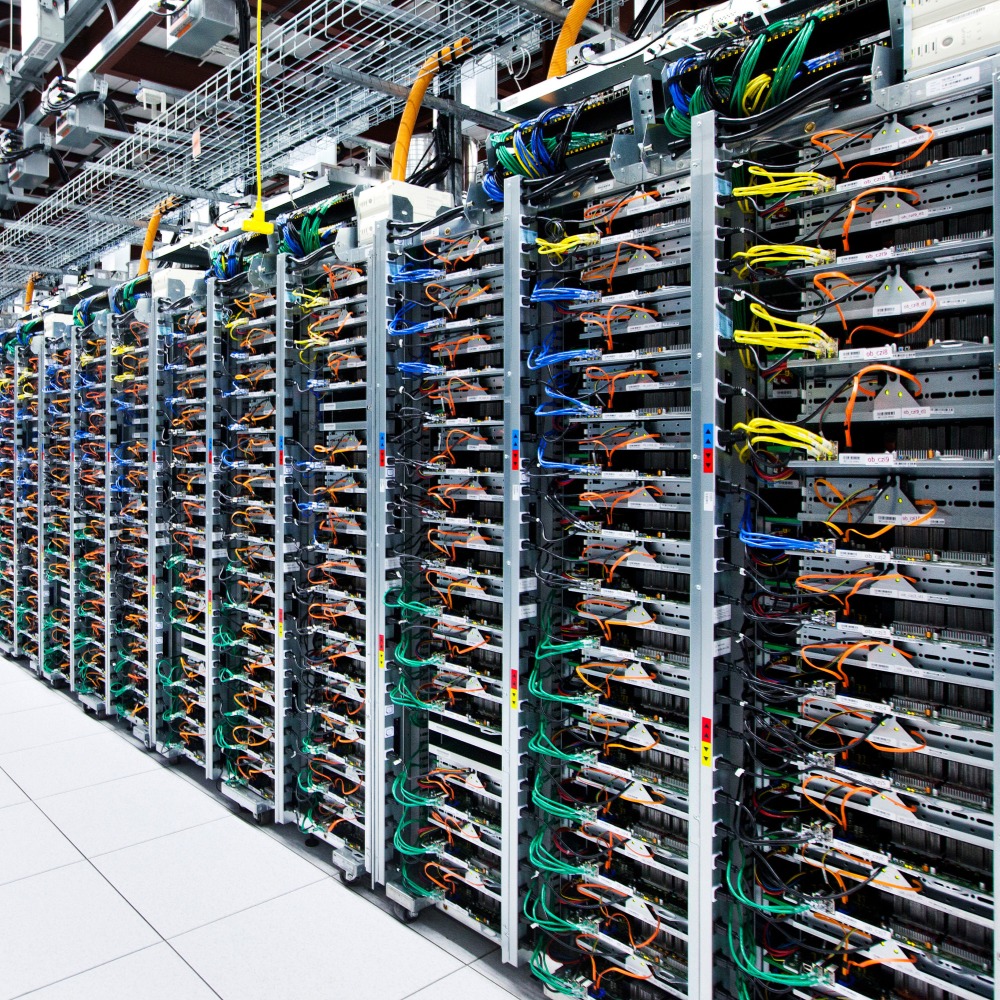
What are Data centers? Data centers are physical facilities (frequently warehouses) that are built for the purpose of handling and directing high volumes of data and data traffic. They can be equipped with millions of dollars of equipment that powers, stores, processes and transfers data for cryptocurrency, artificial intelligence, analysis and planning. They are high energy and water consumers, impacting local resources and contributing to climate change. The large hyperscale AI Data centers pose the greatest impact both on the environment as well as quality of life factors for those that work or live near to the centers. The smaller data centers of schools, colleges, banks, hospitals, businesses, and credit card companies and the numerous co-location centers that are used for redundancy have more limited impact.
LWV Metro STL, LWV MO and the Environmental Quality and Climate Committee (EQC2) of Metro STL have a long history of providing education and advocacy on numerous environmental issues and concerns. The Data Center Map13 lists 18 data centers in the St Louis area that are operated by 9 different companies. These centers are located throughout the St Louis metropolitan area, including the city and county. Data centers in the region are growing with new projects being presented and developed. There are numerous small scale data centers (used by banks, businesses, credit card and health care companies, labs, hospitals, and insurance and medical offices) and a limited number of co-located data centers (support back up for hyperscale centers located at another site). All data centers are not alike; the small-scale data centers and many of the co-located data centers have a much smaller carbon footprint and reduced impacts on the environment and quality of life. St. Charles County recently placed a one-year moratorium on a proposed Google hyper center.
The hyper-scale data centers can bring significant risks and impacts to states and communities, including in Missouri and in the St. Louis region, on water and energy supplies and on quality of life (light and noise pollution) that will impact all living beings near these large data centers. Large data centers change out servers and chips during regular maintenance, creating the need for metals and minerals that could also have implications for mining in Missouri (MO does have a cobalt deposit). The large data centers consume a lot of energy, and utilities will have to scramble to meet this demand, potentially leading to delays in scheduled coal plant retirements or the construction of new fossil fuel plants (for instance the natural gas plant planned near the confluence of the Meramec and Mississippi rivers). While data centers are critical and necessary in our current world for activities from cell phone communication, data analysis and processing, Cloud storage, credit card usage, banking, and medical records transfers to more national issues such as security and defense, their construction requires information and careful consideration.
In mid-September, St Louis City was asked to consider the construction of a data center in the Armory building. Two town hall meetings were held to gather public feedback on the proposed data center. The EQC2 used our research on Data Centers to develop A Data Center Fact Sheet, and information was developed and presented at the September LWV Metro STL City Unit Meeting. LWV Metro STL published the public hearing opportunities in the League’s weekly email, Things To Do, at the September City Unit Meeting, and using social media. At various LWVUS Climate Interest Group Team Meetings, including Renewable Energy on Oct 7, the question was raised as to the appropriateness of education and advocacy on data centers using LWVUS positions. The committee members concurred on the selected choice of LWVUS positions to justify education and advocacy for public participation. The Renewable Energy Committee will work to develop a toolkit that local and state leagues can use to discuss the complex topic of data centers.
St. Charles, Kansas City and St Louis are all facing requests for additional large data centers. The League of Women Voters Interleague Organization of the Upper Mississippi River Region (UMRR) has seen devastation in Minnesota, Wisconsin, Illinois, and Iowa from data centers that remains confidential and with limited public knowledge or participation. Impacted areas have seen ground water levels decrease as the data centers remove water for cooling. Rate payers are paying more for the building of new power plants and infrastructure, including electric grid expansion. Communities near the data centers are left to deal with the quality of life and environmental justice concerns. Cities and local governments are enticed by the opportunity to use vacant buildings and the creation of jobs to fast-track data centers without consideration of the impacts on local resources, quality of life, or the environment. While the promise of jobs and use of inner-city properties is enticing, increased jobs are not in fact a major benefit of data centers. Consultants estimate the Armory project would create 600 jobs during construction, but with only approximately 30 full-time technical staff to run and maintain the data center. There could be an additional 106 indirect jobs.
Data centers requirement for confidentiality is a complicated concern including their need to protect sensitive data, ensure compliance (legal and regulatory), reduce data breaches, and safeguard competitive advantage. To avoid taking on debt, the companies building date centers use private equity firms to raise the funds to build the center. This results in a lack of transparency and also avoids citizen oversight of the siting process.
The League is well suited to advocate and educate on this issue. The League can work to ensure public participation and open transparency in the siting of data centers and can make recommendations on the important questions that need to be asked to have both the public and government understand and implement necessary protections to protect the environment and quality of life, including:
1. Energy
Reviews by MIT, Forbes, and NPR project data centers’ energy use is continuing to expand with the expansion of AI Data centers.
- Where will the power come from? The $300 million methane/natural gas plant Ameren is building at Meramec confluence and the proposed plant in Jefferson County do not involve clean energy and have large carbon footprints. In addition, the Labadie Coal plant (the second deadliest plant in the US) will not be retired.
- Will renewable energy be prioritized over methane and fossil fuels? Communities and governments could require that data centers install as much clean energy, such as solar or wind power, as possible to generate their power needs.
- How will the center minimize the use of diesel generators for backup? A requirement for battery backup storage would reduce the need to rely solely on diesel generators.
2. Utility Rates
- How will ratepayers be protected from cost increases? A bill that was signed by Governor Kehoe (R) this year allows Ameren to charge rate payers for the building of new power plants.
- How to ensure that the data centers will pay their share of the power plant build costs? Data centers are coming to the Midwest for a stable grid and lower energy costs, vacant properties, and lower costs of living and taxes. The rapid growth in the number of data centers in the Midwest requires government and public participation to ensure that large data centers pay their share of costs and protect the environment. The current energy pricing system is not working for communities with such large 24/7 energy users. Most power utilities participate in a system of sending excess power to the US grid. When large users exceed the power generated, they must purchase power at an emergency rate from the grid, and that excess rate charge is applied to all customers. Currently rate systems applied to data centers use the same rules that are applied to large urban consumers – this does not make sense for data centers that require the added cost of transfer grid development and the building of new power plants, as well high-use 24/7 energy consumption. Data centers in VA, NJ, MN, WS, and IL have all led to increased emergency power charges for all rate payers when power use by the data centers exceeds the utility’s capacity. Emergency charges that are excessive are then added to utility bills. Communities and governments need to make sure that small users are not burdened by these emergency charges generated solely by data centers in the area, nor should small consumers have to pay an unfair share of the construction costs required, both to the grid and the power plant itself.
3. Water
- How much water will the center consume daily? There has been some news coverage on Amazon working to conceal the amount of their actual water usage.
- How will wastewater be treated and discharged?
- What water conservation systems will be employed to conserve and reduce water waste and contamination?
4. E-waste
- What commitments will the company make to responsible e-waste recycling and reduction of toxic e-waste?
5. Noise and Light Pollution and Livability
- What steps will be taken to eliminate or mitigate noise pollution for residents, workers, wildlife and ecosystems near the data center ?
- What measures will the data center employ to reduce the impact of light pollution on residents, workers, and wildlife that live nearby ?
6. Transparency
- How will the data centers and government allow for public oversight with confidentiality agreements in place?
- How will citizens be informed and included in the planning and zoning processes?
The League can play an important role as data centers expand in the St Louis Region and throughout Missouri. The League can advocate and educate to ensure transparency of the process, work to limit environmental justice and quality of life impacts, and protect our natural resources.
Additional Reference and Fact Sheets on Data Centers
- Data Centers have been the focus of numerous webinar and meetings including: LWVUS, Sierra Club, Missouri Clean Energy Coalition, and the LWV Interleague organization of the Upper Mississippi River Region. Data Centers were also discussed at the Missouri Environmental Summit on September 30 in Columbia. The LWVUS CIG Renewable Energy Committee, LWVUS Climate Interest Group Steering Committee and the LWVUS CIG Water Committee supported using League positions to educate and advocate for public participation, transparency and mitigation of the energy, water, noise, light and other impacts of large data centers.
- Link to the Missouri Coalition for the Environment (MCE) blog on KC Data Centers https://moenvironment.org/blog/ai-and-data-centers-in-kansas-city/
- Fact Sheet Data Center National League of Cities https://www.nlc.org/resource/fact-sheet-understanding-data-centers/
- Fact Sheet from Virginia impacts https://www.pecva.org/work/energy-work/data-centers-industry-impacts-in-...
- Link Piedmont Environmental Council page https://www.pecva.org/our-work/energy-matters/data-centers-energy-demand/
- Sierra Club Fact Sheet https://www.sierraclub.org/sites/default/files/2025-07/data-center-facts...
- FAQs Data Center. Data Center Coalition https://www.datacentercoalition.org/cpages/faq#:~:text=Frequently%20Aske...?
- Fact Sheet US EPA NOTE this was prepared to support current administration push for Data Centers
https://nepis.epa.gov/Exe/ZyNET.exe/P100WUQA.TXT?ZyActionD=ZyDocument&Cl... - Data center video Webinar LWV ILO UMRR https://www.youtube.com/watch?v=PBGuaTCloeQ&t=2s
- Data Centers CS Monitor Newsletter 3/21/2025https://www.csmonitor.com/Environment/2025/0320/data-center-alley-power-...
- https://www.npr.org/2025/10/14/nx-s1-5565147/google-ai-data-centers-grow... "Data centers are booming. But there are big energy and environmental risks" by Michael Copley
- A program covers the paper trail of ownership of data centers. https://www.youtube.com/watch?v=LInqha7QlzY and https://youtu.be/YKDFlOmc95Y
- Data Center Maps and Location https://www.datacentermap.com/usa/
- PBS https://www.pbs.org/video/data-centers-ppqzck/