
On November 3rd, voters will elect those who will exercise POWER over our lives.
The results of this contest will determine the majority and minority balances in both the U.S. Congress and the PA General Assembly. Those elected for U.S. Congress decide what Federal laws are written on issues that impact our lives - taxes, civil rights, voting rights, immigration, climate, tech, infrastructure, tech/AI, and healthcare. Our state officials make rules and laws about issues like education, minimum wage, fair housing, gun safety, reproductive rights, taxes, healthcare, and elections.
U.S. Representatives serve two-year terms in Washington, DC. They introduce and vote for or against resolutions, bills, and amendments. They approve the budget and serve on policy committees such as those for agriculture, energy, foreign affairs, judiciary oversight, and small businesses. They also have the power to send articles of impeachment of elected officials to the Senate. ALL seventeen U.S. Representatives from Pennsylvania will be elected this fall; no U.S. Senators are on the ballot.
In Pennsylvania, we will elect all of our State Representatives and one-half of our fifty State Senators who work in Harrisburg. It is important that you know what these elected officials do.

PA State Senators are elected from districts to four-year terms. In collaboration with the state's House of Representatives, they create budget packages, make tax decisions, determine spending and pass laws. They authorize appointments of the Governor and can try officials impeached by the House. Senators also serve on committees such as those involved with Labor, Health/Human Services, and Environmental Resources and Energy.
PA State Representatives are elected for two-year terms in even-numbered years. Each of the 203 districts represent a nearly equal number of constituents. Our state representatives work with the Senate to develop budgets, decide taxes, make redistricting decisions, and pass laws. Representatives have the exclusive power to impeach elected officials. Members serve on a variety of committees, from Education and Aging to Finance and Liquor Control.
PA Governor is the Commonwealth's chief executive who proposes state budgets, signs or vetoes legislation, oversees state agencies, and works with the State Legislature on policies about economic development, public safety and emergency management. The Governor is also the Commander in Chief of the PA National Guard during a four-year term.
PA Lieutenant Governor is elected together with the Governor on a single ticket since they work as a team. He/She is first in line to succeed the Governor, presides over the PA Senate, and casts tie-breaking votes. The Lt. Governor chairs the Board of Pardons and leading groups such as the Local Government Advisory Committee and the Emergency Management Council.
Steps You Can Take When Selecting a Candidate
Choosing a Candidate is no simple task. Between AI, and intrusions by foreign countries and bad actors, you will be flooded with information and disinformation. Try to see through the smoke and mirrors.
Ask yourself:
- Do they make you angry or fearful?
- Do they name-call and try to spread rumors?
- Do they ignore issues, blame others or promise unrealistic solutions?
- Is it all about fluff or substance?
Check out the sources of media polls and samples:
- Who sponsored the poll and was the sample large and representative?
- When was it conducted?
Rate Candidates by Considering:
- Their availability
- Their qualifications
- Their voting record
- The clarity and information on their websites.
- The sources of their funding.
- What issues are important to you.
- What changes you would like to see.
- The history and background of those running for office.
Use this QR code to check out VOTE 411.org, the League's non-partisan source of election information.

Make a Plan to Vote
Planning to Vote is important. Do it NOW. Check your registration status at the Pennsylvania Department of State website by linking via the second QR code. Make changes in name, party affiliation, and address as needed. If you are voting by mail, watch the deadlines. Make sure you apply for an application, follow the directions, and submit it in a timely manner.
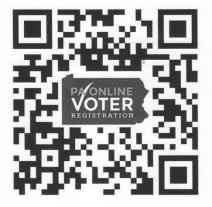
If you are voting in person, know where your polling place is located, when you will go, and how you will get there. If you are voting for the first time at a polling place, bring an approved ID. Do not leave without voting; always ask for a provisional ballot if you are questioned.
If you experience trouble, go to Election Protection: 866 OUR VOTE.
Options for College/University Students include going home to vote, voting by mail, or voting where you currently receive mail. Use your home address if you wish to return home to vote or vote for candidates in your home district by mail-in ballot. If you want to vote where you currently live, register to vote using your current address at least fifteen days before the election.

Claiming Your Power is Up to You.
It's your voice that affects your everyday issues from housing and healthcare to food prices and taxes. Don't let others decide for you. Information is power. Use the QR codes to access resources to become an informed and awesome voter!
Article by Roberta Winters, President League of Women Voters of Delaware County, ILO