July Month Long Observances
- Black, Indigenous, and People of Color (BIPOC) Mental Health Month
- French-American Heritage Month
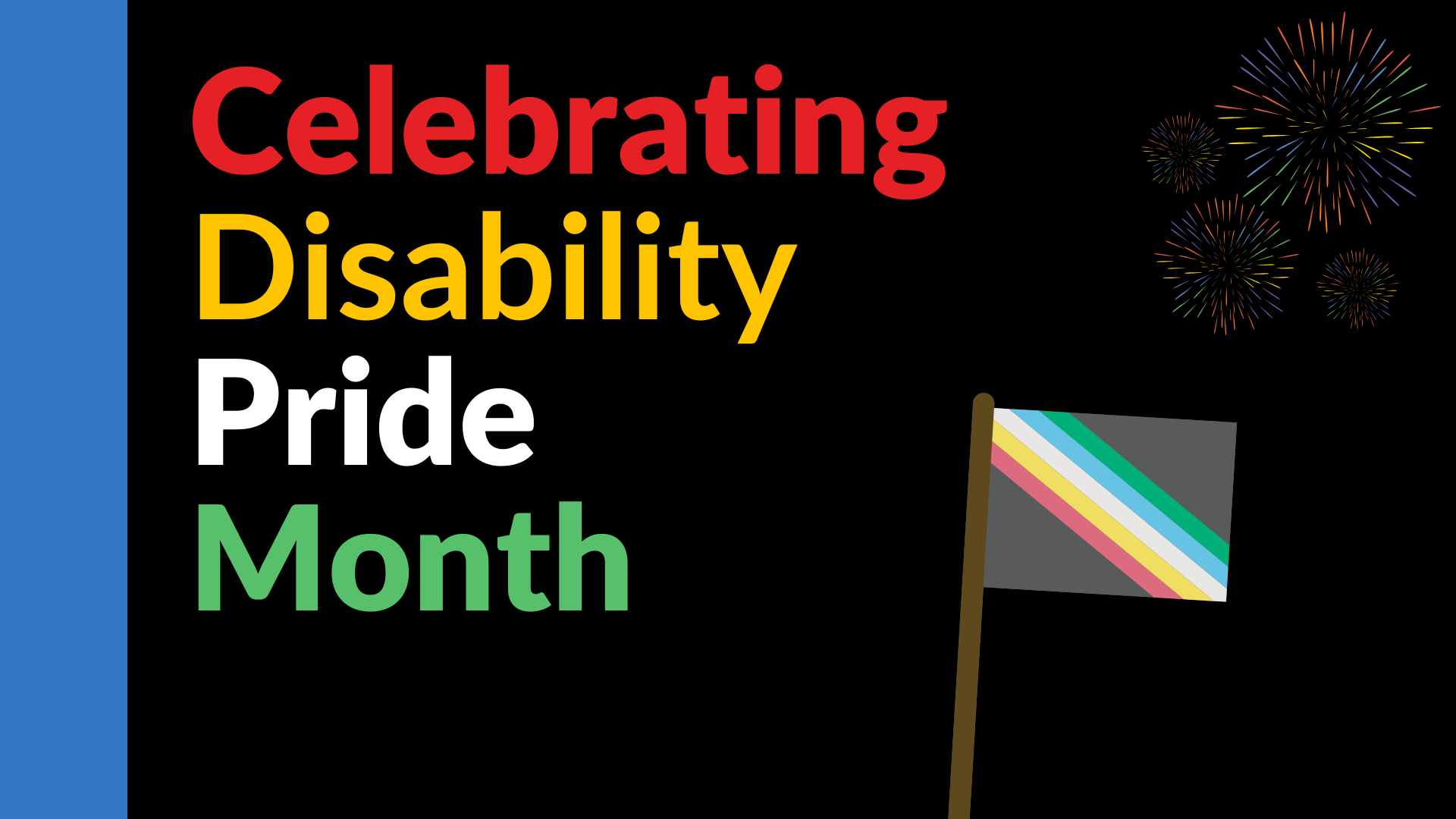
Disability Pride Month
Did you know that July is Disability Pride Month? This is a time to celebrate the diverse community of people with disabilities, reflect on the progress that has been made toward equity and accessibility while recognizing the work that remains to build inclusive communities where people with disabilities can thrive with dignity and self-determination. For instance, major inequalities persist in transportation, digital access, physical barriers and many other areas that prevent more than one billion people with disabilities, worldwide, from fully participating in society.
Disability Pride Month is celebrated in July, commemorating the signing of the Americans with Disabilities (ADA) enacted on July 26, 1990. This law was a landmark that extended civil rights protections to people with disabilities.
The Disability Pride Month flag is a charcoal gray flag with five parallel colored stripes in a diagonal band that runs from the top left to the bottom right corner:
- Red: Represents physical disabilities such as stroke, arthritis, and spinal cord injuries
- Gold: Represents neurodiversity such as autism spectrum disorder, brain injuries, and attention-deficit/hyperactivity disorder
- White: Non-apparent (invisible) disabilities and undiagnosed disabilities
- Blue: Represents emotional and psychiatric disabilities, including mental illness, anxiety, and depression
- Green: Represents sensory disabilities such as deafness, blindness or low vision, lack of smell, lack of taste, audio processing disorder, and all other sensory disabilities
- Black background: Represents mourning and rage for victims of ableist violence and abuse
- Diagonal Stripes: Symbolizes cutting across barriers that disabled people face, and is meant to allude to the idea of light cutting through the darkness.
- The flag's design also commemorates and mourns disabled people who have died due to ableism, violence, negligence, suicide, or other injustices, while honoring the resilience and activism of the disability community.
July 2 – Thurgood Marshall’s Birthday
Thurgood Marshall was the first Black Justice on the U.S. Supreme Court. Before joining the Court, he was a prominent civil rights attorney and is widely known for serving as lead counsel for the NAACP in Brown v. Board of Education (1954). Marshall helped change the course of the United States when the Supreme Court ruled that racial segregation in public schools was unconstitutional. The decision began the dismantling of legalized racial segregation in education and rejected the "separate but equal" doctrine established in Plessy v. Ferguson (1896).
July 4 – U.S. Independence Day
July 4 marks the day in 1776 when the United States declared its independence from Great Britain. The Declaration of Independence was adopted by the Continental Congress, stating that the 13 American colonies were now free and independent states. Today, the holiday is celebrated with fireworks, parades, and gatherings that commemorate the nation's founding, while also providing an opportunity to reflect on the ongoing pursuit of liberty, equality, and justice for all.
July 10 – Baha’i: Martyrdom of the Báb
The Martyrdom of the Báb is one of the most important holy days in the Baháʼí Faith. It commemorates the execution of the Báb, whose title means "the Gate." Baháʼís regard him as a Messenger of God who prepared the way for Bahá'u'lláh, the founder of the Baháʼí Faith.
In 1844, the Báb announced that he had received a message from God and began sharing his teachings in Persia (modern-day Iran). His teachings attracted many followers but also faced strong opposition from religious and political authorities. After several years of imprisonment, he was publicly executed by a firing squad in Tabriz on July 9, 1850.
According to Baháʼí accounts, when the first volley of shots was fired, the Báb was not harmed and was found completing a conversation with a companion. He was then brought back and executed in a second round of firing. Baháʼís view these events as significant demonstrations of his spiritual mission.
The Martyrdom of the Báb is a solemn occasion that:
- Honors the Báb's sacrifice and steadfast faith.
- Reflects on themes of courage, devotion, and religious freedom.
- Recognizes the Báb's role in preparing the way for Bahá'u'lláh.
- Encourages believers to uphold justice, compassion, and service to humanity.
Observance
Baháʼís observe the holy day through:
- Prayer and devotional gatherings.
- Readings from Baháʼí scriptures.
- Reflection and remembrance.
The Martyrdom of the Báb is one of the nine holy days in the Baháʼí calendar on which work is suspended. Today, the Báb's remains are interred at the Shrine of the Báb in Haifa, Israel. The shrine and its surrounding gardens are part of the Baháʼí World Centre and are among the most sacred sites in the Baháʼí Faith.
July 14 – International Non-Binary People’s Day
International Non-Binary People's Day celebrates the diversity, visibility, and resilience of people whose gender identities fall outside the traditional categories of exclusively male or female. The term "non-binary" refers to individuals who do not identify solely as a man or a woman; some may identify as both, neither, or move fluidly between genders. "Enby" is the phonetic pronunciation of "NB," which is short for "non-binary."
The day aims to raise awareness about the unique challenges non-binary people face, including discrimination, lack of legal recognition, violence, and, for some individuals, gender dysphoria (a sense of distress when one's gender identity does not align with the sex they were assigned at birth). While significant work remains in the pursuit of full equality and recognition, this day also celebrates the achievements, visibility, and contributions of non-binary people around the world. It provides an opportunity to uplift voices within the community and promote authentic, diverse representation.
Take Action
Celebrate International Non-Binary People's Day by learning about non-binary identities, listening to and amplifying non-binary voices, respecting individuals' names and pronouns, and advocating for inclusive policies and practices in your workplace, school, and community. Small actions can help foster environments where everyone is seen, respected, and valued.
July 14 – Bastille Day
Bastille Day, celebrated on July 14, commemorates the storming of the Bastille prison in Paris in 1789, a pivotal event at the beginning of the French Revolution. At the time, many people in France were frustrated by economic hardship, social inequality, and the power of the monarchy. Although the Bastille held few prisoners, it was widely viewed as a symbol of royal authority and arbitrary imprisonment. Its capture by revolutionaries became a powerful symbol of resistance and marked a turning point in the movement for political change. Today, Bastille Day is France's national holiday and celebrates the enduring ideals of liberty, equality, and fraternity.
July 18 – August 17: South Asian Heritage Month
South Asian Heritage Month (SAHM) is a month-long observance that takes place from July 18 to August 17 to celebrate and reflect on the rich histories, cultures, and contributions of people from the South Asian diaspora. The diaspora includes communities with heritage from Afghanistan, Bangladesh, Bhutan, India, the Maldives, Nepal, Pakistan, and Sri Lanka.
SAHM was first established in the United Kingdom in 2020 by community organizations to promote education and awareness of South Asian histories and identities. It highlights the diversity within South Asian cultures and explores shared histories shaped by migration, colonialism, and identity, as well as the contributions of South Asian communities to British society.
The timing of SAHM is historically significant:
- July 18 marks the passage of the Indian Independence Act in 1947, which set the legal process for the independence and partition of British India into India and Pakistan.
- August 17 commemorates the announcement of the Radcliffe Line, which formalized the border between India and Pakistan, triggering one of the largest mass migrations in history, accompanied by widespread violence and the deaths of hundreds of thousands.