WI CONSTITUTIONAL AMENDMENT ON NOVEMBER 3, 2026 MIDTERM BALLOT -
VOTE NO ON ALL THREE CONSTITUTIONAL AMENDMENTS
| Educational Anti-equity Constitutional Amendment Toolk | What You Need to Know Series and Webinar |
Find information on the other two proposed constitutional amendments
WHAT YOU NEED TO KNOW ABOUT THE ANTI-EQUITY REFERENDUM/AMENDMENT:
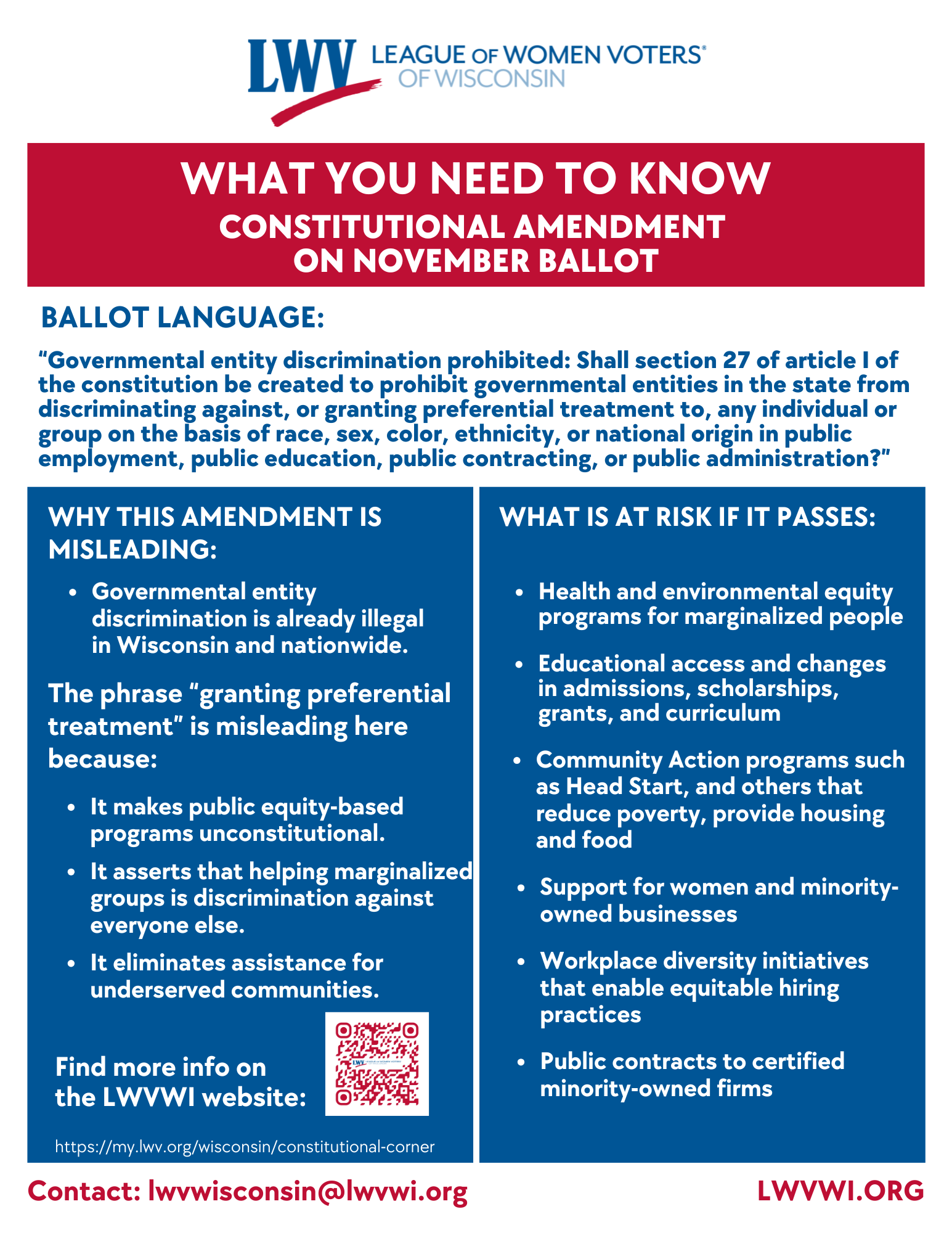
BALLOT LANGUAGE*
WHAT THIS AMENDMENT MEANS?
WHAT CAN HAPPEN IF THIS AMENDMENT PASSES?
Government programs that help people have an equal chance to succeed would be unconstitutional, ending decades of work to fix inequality.
-
What will be gained: Nothing
-
What will be lost: 60 years of progress for women and people of color
WHAT PROGRAMS AND POLICIES COULD BE ELIMINATED?
-
Health and Environmental Equity: Higher rates of chronic illness, disease and mortality and maternal mortality for Black women
-
Education: Changes to K-12 accommodations, curriculum; changes to UW admissions, scholarships, grants, courses, textbooks
-
Community-Action Programs: Head Start and social-support networks for operating food banks, homeless shelters, and domestic violence shelters
-
Government, Businesses, and Contracts: Workplace initiatives for women, public contracts for certified minority-owned firms, policies that enable equitable hiring, promotion and retention; and the Wisconsin Supplier Diversity Program
*The language of this constitutional amendment as it will appear in the Constitution is more expansive than the Question on our ballots. Read more below:
[Article I] Section 27 (1) In this section, “governmental entity” means the state, its
political subdivisions including municipalities, the University of Wisconsin System, the Technical
College System, any public college or university, any public school district, and any office,
department, independent agency, board, commission, authority, institution, association, society,
or other body in state or local government created or authorized to be created by the
constitution or any law, including the legislature and the courts.
(2) A governmental entity may not discriminate against, or grant preferential treatment
to, any individual or group on the basis of race, sex, color, ethnicity, or national origin in public
employment, public education, public contracting, or public administration.
(3) This section does not prohibit action that must be taken to establish or maintain
eligibility for any federal program, if ineligibility would result in a loss of federal funds to the
governmental entity.
(4) Nothing in this section prohibits bona fide qualifications based on sex that are
reasonably necessary to the normal operation of public employment, public education, public
contracting, or public administration.
(5) If any part or parts of this section are found to be in conflict with the United States
Constitution or federal law, the section shall be implemented to the maximum extent that the
United States Constitution and federal law permit. Any provision of this section held invalid shall
be severable from the remaining portions of this section
Two Additional Constitutional Amendments Appearing on the November Ballot
Wisconsin Constitutional Amendment to Prohibit Closure of Places of Worship in response to a state emergency:
The amendment would prohibit the state or any political subdivision, such as cities and counties, from ordering the closure of, or forbidding, gatherings in places of worship in response to a state of emergency, including a public health emergency.
What constitutes a state of emergency in Wisconsin?
Under Wisconsin Statute 323.10, the governor may issue an executive order declaring a state of emergency for the state or any portion of the state if they determine that an emergency from a disaster or an imminent threat of a disaster exists.
The governor can also make the same determination for public health emergencies and can issue an executive order declaring a state of emergency related to public health. The governor is also authorized to designate the Department of Health Services as the lead state agency to respond to that emergency.
-
A "yes" vote supports this amendment to prohibit the state or any political subdivision from ordering the closure of or forbidding gatherings in places of worship in response to a state of emergency, including public health emergencies.
-
A "no" vote opposes this amendment to prohibit the state or any political subdivision from ordering the closure of or forbidding gatherings in places of worship in response to a state of emergency, including public health emergencies.
Wisconsin Constitutional Amendment Prohibits Governor’s Partial Veto to Increase Tax or Fee Amendment
[Article V] Section 10 (1) (c) In approving an appropriation bill in part, the governor may only reject one or more entire bill sections capable of separate enactment as a complete, entire, and workable law and reduce appropriations in the enrolled bill.
A partial veto, also referred to as a line-item veto, is a power that authorizes a chief executive — such as the president or the governor of a state — to reject specific provisions of a bill, rather than the entire bill.
Other constitutional amendments have been passed to restrict the governor’s partial veto power:
-
The 1990 Amendment Prohibiting Creating New Words In 1990, voters ratified a constitutional amendment limiting the Governor’s partial veto authority by prohibiting the creation of a new word by rejecting individual letters in the words of an enrolled bill. [1989 Enrolled Joint Resolution 39; Wis. Const. art. V, s. 10 (1) (c).]
-
The 2008 Amendment Prohibiting Combining Parts of Sentences In 2008, voters ratified a constitutional amendment limiting the Governor’s partial veto authority by prohibiting the creation of a new sentence by combining parts of two or more sentences of the enrolled bill. [2007 Enrolled Joint Resolution 26; Wis. Const. art. V, s. 10 (1) (c).]
-
A "yes" vote supports amending the Wisconsin Constitution to prohibit the governor from using the partial veto to create or increase any tax or fee.
-
A "no" vote opposes amending the Wisconsin Constitution to prohibit the governor from using the partial veto to create or increase any tax or fee.